

Garbha Sanskar and Garbhavastha: The Ancient Ayurvedic Wisdom of Pregnancy the Modern World Forgot
6/02/2026

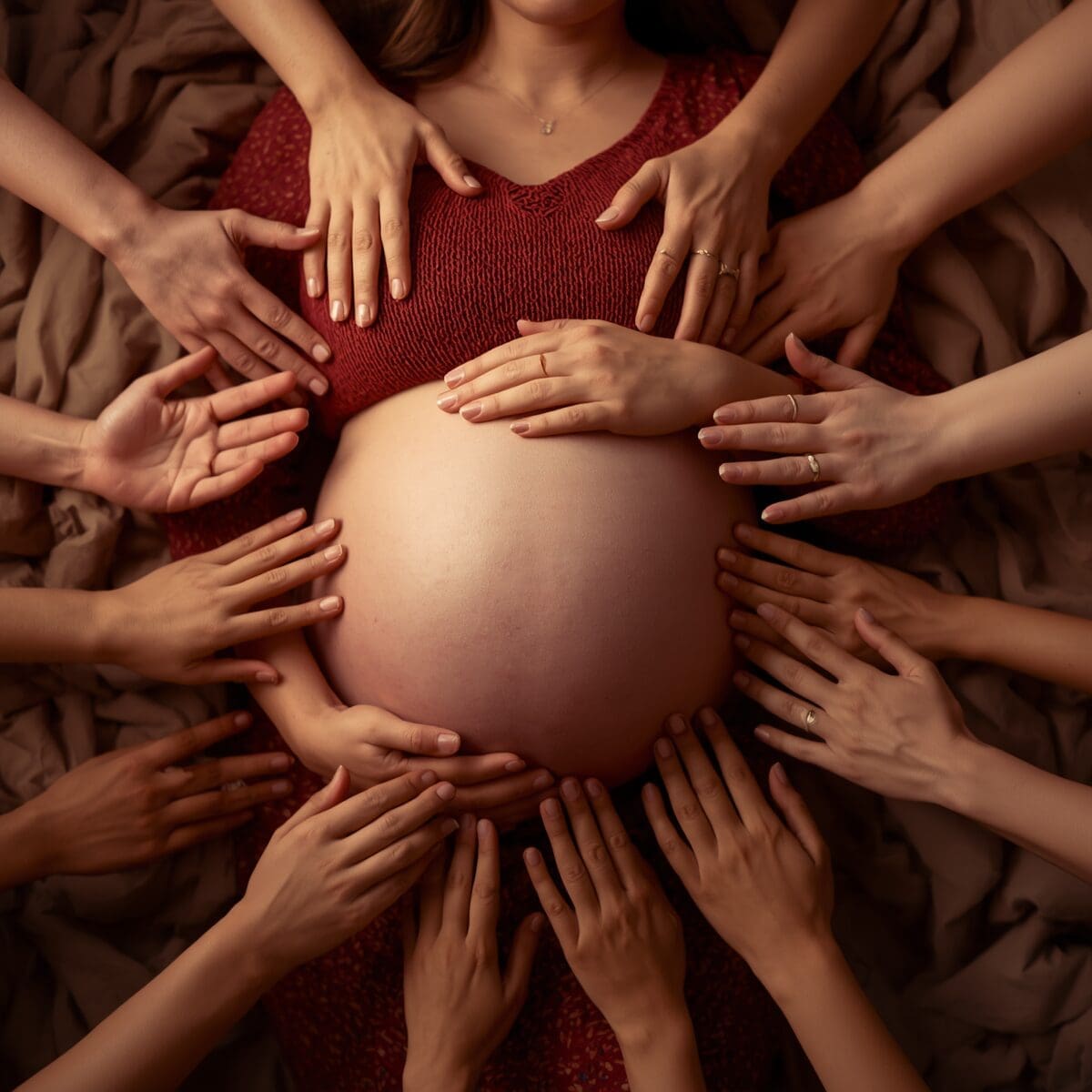
What Ayurveda and the Vedic scriptures always knew about pregnancy, what the modern West has quietly forgotten, and how we begin to remember — even from afar, even alone, even now.
A PERSONAL CONFESSION
I was that woman. The one who raised an eyebrow at the pregnant Indian women in my family who were living in India — the ones who seemed to slip, almost too willingly, into a state of softness. Who stopped work. Who hired household helpers to do the housework and cooking. The ones who needed a driver to escort them around. Who allowed themselves to be fed, pampered, carried through their days by mothers and mothers-in-law and sisters, wrapped in an invisible cocoon of collective care. I watched them and thought, a little smugly: You are pregnant, not ill. Why can’t you simply continue? Here in Europe the women do all this on their own and do not complain.
I was young, and ambitious, and I had built my identity on the idea that I could do everything a man could do — and everything a woman was expected to do — simultaneously, without flinching. Career, independence, capability: these were my religion. The idea of surrender, of needing, of being tended to, felt embarrassing to me. I would sometimes even smirk, privately, at how these women seemed to become almost childlike again in their families’ eyes — being indulged, their every craving humoured, their every discomfort anticipated and soothed. To me this is weakness dressed in tradition.
What I could not yet see was that I was watching something ancient and wise in motion.
I was too proud and too young and too armoured in my own idea of strength to see that those women were not being weak. They were being held. And holding, it turns out, is one of the most profound things one human being can offer another, especially when a woman transitions into a mother. What I had mistaken for dependency was, in fact, a sophisticated, millennia-old understanding of what a woman’s body, mind, and spirit require during the most radical transformation of her life.
Only now am I able to see how naive and blind and full of ego I was. This is such a strange and disorienting phase — it has completely thrown me off the path I thought I was on. I don’t know what I would do without my husband, who runs around for me and takes care of me in ways that moves me daily. And I am lucky not to have to sit at a 9-to-5 job in an office, following someone else’s schedule and priorities. But I feel the lack of a women community around me dearly. The lack of my mother. My mother-in-law. My sister. My best friends, who would have offered a very different quality of attention — something my husband cannot give.
And I feel something else too — something I think we rarely say out loud. The weight we place on our partners, silently and without ceremony, as though it were the most natural thing in the world. We expect them to step up and be everything: the village elder, the mother, the sister, the doula, the financial anchor, the emotional container. And we call this love. And in many ways it is. But we underestimate what it costs them. Quietly, invisibly, they are carrying something that was never designed to be carried by one person.
This article is my attempt to understand what we have lost — as individuals, as couples, as a society that replaced the village with the nuclear family and called it progress. And how, even now, even from afar, even bound to work, even without a mother in the next room — we might gently, practically, find our way back.
— I —
Two Philosophies, One Root: Garbhavastha and Garbha Sanskar
What I witnessed as a young woman and felt dismissive about back then, is actually part of an ancient philosophy and concept that has been practiced in India for thousands of years.
Before we go further, it is worth pausing on the two Sanskrit concepts at the heart of this article — because they are related but distinct, and understanding the distinction illuminates everything that follows.
Garbhavastha translates as “the state of the womb.” It is the comprehensive Ayurvedic framework — the entire philosophy of how a pregnant woman should be nourished, protected, and supported across all nine months. Diet, rest, herbs, community, ritual, emotional environment: all of it together. Garbhavastha is the whole architecture of pregnancy care.
Garbha Sanskar lives within that architecture. Garbha means womb; Sanskar means impression, refinement, the conscious shaping of character. It is the specific and intentional practice of communicating with, educating, and nurturing the consciousness of the child while it still resides in the womb — through sound, mantra, meditation, prayer, positive thought, yoga, and the deliberate cultivation of the mother’s inner world.
Together, they form something radical: a complete philosophy of prenatal life that insists the baby is not a passive passenger in the mother’s body but an aware, sensitive, impressionable being — one who is already, from the earliest weeks, absorbing the emotional and spiritual atmosphere in which it is being grown.
“The mother’s inner world is not separate from the baby’s world. It is the baby’s first world — the original home, the first teacher, the first impression of what it means to be alive.”
This is not metaphor. The ancient texts knew it. And now, remarkably, modern science is beginning to confirm it.
— II —
The Garbha Upanishad: When the Soul Arrives
Among the 108 Upanishads of the Vedic tradition, the Garbha Upanishad occupies a singular place. Part of the Krishna Yajurveda, it is dedicated entirely to the mystery of life in the womb — addressing questions that modern embryology has only recently begun to approach, and questions that science may never fully answer: when does consciousness arrive? What does the soul experience before birth? What does it know, and what does it forget?
The text describes the formation of the embryo in precise physiological terms — the five great elements (earth, water, fire, air, ether) combining under the guidance of prana, the life force. It traces the gradual crystallisation of body and mind across nine months with a detail that continues to astonish researchers. But what makes it extraordinary is its account of consciousness itself — of the soul’s growing awareness of itself, its past lives, and its purpose in taking birth again.
| THE GARBHA UPANISHAD — MONTH BY MONTH Body and soul developing together, from the very beginning. In the first month, the embryo is a mingled mass — a vesicle after seven nights, a spherical mass within a fortnight, a firm settled form by the month’s end. In the second, distinct shape emerges from the formless. In the third, limbs begin their long work of forming — and it is here that the Charaka Samhita says jiva, consciousness, enters. In the fourth, the belly and hips take shape; the senses begin their opening. In the fifth, the back and spine form — the body’s central axis, its channel for prana. In the sixth, the nose, the eyes, the ears open to a world they cannot yet enter. And in the seventh month — the Garbha Upanishad is specific and extraordinary about this — the soul becomes fully conscious. The fetus begins to reflect on its past lives, to understand the karmic weight it carries, to contemplate its purpose in taking birth again. It experiences, within the sealed world of the womb, something approaching enlightenment. It makes a vow. And then, as birth approaches, the pressure of passage causes a great forgetting. The vow dissolves. The soul enters the world clean, innocent, and ready to begin again. |
What the Garbha Upanishad is telling us — what it has been telling us for thousands of years — is that the being in the womb is not a biological process awaiting completion. It is a consciousness, arriving. And that consciousness is not sealed off from the mother’s experience. It is immersed in it, shaped by it, listening through the fluid walls of its first home to everything the mother thinks, feels, fears, prays, and loves.
This is the philosophical bedrock of Garbha Sanskar. If the baby is already aware — already, from the earliest months, a presence rather than merely a process — then everything the mother experiences matters. Not abstractly. Physically, hormonally, neurologically, spiritually. The mother’s anxiety is the baby’s anxiety. The mother’s peace is the baby’s peace. Her music reaches the baby. Her breath reaches the baby. Her prayers reach the baby. Her heartbeat is the baby’s entire world.
— III —
The Classical Framework of Garbhavastha
The Charaka Samhita and Sushruta Samhita — Ayurveda’s foundational texts, composed thousands of years ago — dedicate entire chapters to garbhini paricharya: the total care of the pregnant woman. Month by month, they prescribe diet, herbs, rest, ritual, and emotional environment. Woven throughout is the Garbha Sanskar philosophy — the understanding that the physical and the spiritual cannot be separated, that what the mother consumes with her mind is as significant as what she consumes with her body.
| Period | Theme | Garbhavastha Care | Garbha Sanskar Practice |
|---|---|---|---|
| Month 1 | The Seed Awakens | Cool, sweet, liquid nourishment. Absolute gentleness. No disruption of body or mind. | Begin with conscious intention. Speak softly to the new life. Let your thoughts be prayers. |
| Month 2 | Form Takes Shape | Milk infused with Shatavari. Warmth and rest. The body’s work is immense — do not compete with it. | Begin pranayama. Your breath oxygenates the growing form. Your calm is their calm. |
| Month 3 | Consciousness Enters | Jiva enters the body. The mother’s desires (dauhridya) now shape the child’s character — they are to be fulfilled with care, not denied. | Begin mantra japa — the Gayatri Mantra, Om Namah Shivaya. Vibration reaches inward. The Punsavan Sanskar ritual is traditionally performed this month. |
| Months 4–5 | The Body Doubles | Heart and mind develop. Intense cravings arise — texts advise they be fulfilled gently, as denying them may affect the child’s disposition. | Talk to your baby. Read aloud. Play classical ragas — Yaman, Kalyani. The auditory system is waking. Your voice is being memorised. |
| Months 6–7 | Intelligence Blooms | Intellect (buddhi) and all five senses mature. Oil massage, music, poetry, and prayer become active medicine — the child hears, feels, and registers everything. | The soul is now fully conscious. Deepen meditation. Your spiritual practice is your baby’s first education. The Simantonnayana ritual is performed now. |
| Months 8–9 | The Descent Begins | Ojas — the subtle essence of vitality — moves between mother and child. The most delicate time. Rest, warmth, and protection are non-negotiable. | Release anxiety consciously. Pray for the birth. The last impressions you send will be the first the baby carries into the world. |
Also central to both Garbhavastha and Garbha Sanskar is the concept of Sattvavajaya — the psychological and spiritual care of the mother. Ayurveda understood, long before modern neuroscience confirmed it, that the mother’s emotional state directly shapes the child’s developing nervous system. Happiness, peace, exposure to beauty, music, and uplifting thought were not luxuries to be fitted in if time allowed. They were medicine. They were prescribed.
| MODERN SCIENCE CONFIRMS Studies from Columbia University and the NIH show that prenatal relaxation practices lower cortisol and correlate with healthier birth outcomes. Research in the International Journal of Pediatrics found that infants whose mothers listened to music daily during pregnancy scored measurably higher on orientation and adaptability tests after birth. Epigenetics — the science of how environment influences gene expression — confirms: the womb is not a waiting room. It is a classroom. The mother’s inner world is the curriculum. |
— IV —
Two Worlds, Two Visions of Birth
To understand what has been lost, it helps to place these two paradigms side by side — not to judge one and elevate the other, but to see them clearly, and to feel the distance between them.
| Garbhavastha & Garbha Sanskar | The Modern Western Approach |
|---|---|
| Pregnancy as sacred, liminal state — a soul arriving | Pregnancy managed around an unchanged, continuing life |
| Extended family collectively holds the mother | Care burden falls almost entirely on the partner |
| Mother encouraged to rest, receive, and turn inward | Productivity maintained as long as physically possible |
| Month-by-month protocol: body, mind, spirit, community | Medical monitoring focused on physical parameters only |
| Emotional peace treated as medical and spiritual necessity | Emotional health left to individual resourcefulness |
| Mantras, meditation, pranayama woven into daily life | Spiritual practice, if any, entirely private and optional |
| Baby spoken to, sung to, prayed over from conception | Baby rarely addressed before birth makes it “real” |
| Postpartum (sutika) care continues for 40–90 days | Postpartum support minimal; swift return to work expected |
| The whole village prepares for the child’s arrival | Each couple navigates the transformation largely alone |
This contrast is not meant as a simple celebration of one culture over another. Western obstetric medicine has saved countless lives. Its advances in monitoring, intervention, and neonatal care are genuinely extraordinary. But there is a profound difference between keeping a pregnancy medically safe and holding a mother whole — body, mind, and spirit — through one of the most disorienting experiences a human being can undergo. Modern medicine has largely mastered the former. The latter is where the ancient wisdom still has so very much to offer.
What strikes me most starkly in this comparison is not the diet or the herbs or even the rest — it is the understanding of anxiety. Garbha Sanskar is built, at its philosophical core, on one insight that the West has verified scientifically but failed to build socially around: the mother’s fear, stress, and unrest do not stay in the mother. They pass through her — via the placenta, via cortisol, via the hormonal language the baby is immersed in twenty-four hours a day — and they become the baby’s lived experience.
“You cannot simply tell a woman to be peaceful. You have to build the conditions that make peace genuinely possible. That is what the village was for. That is what Garbha Sanskar understood, and what we have dismantled.”
WHAT ANCIENT EUROPE KNEW TOO
It is important to say this: the distance from embodied, community-held pregnancy is not original to European culture. It is not a Western flaw or an Eastern virtue. Ancient European traditions — Celtic, Germanic, Norse, Mediterranean — also built elaborate rituals around pregnancy and birth. The village midwife, the circle of elder women gathering around the labouring mother, the postpartum seclusion period, the herbal remedies passed mother to daughter across generations: these were universal. Every human civilisation, in every corner of the world, once understood that pregnancy was not a private matter but a communal one.
The shift happened earlier in Europe, and faster. Industrialisation, urbanisation, the rise of the nuclear family as the standard social unit, the movement of women into the formal workforce without any restructuring of domestic support systems — all of this dismantled the extended kinship web across Europe far sooner than it did in India. What India still holds — often unconsciously, as a kind of muscle memory of civilisation, practised before it is named — Europe has largely forgotten. The knowledge went underground. The rituals became superstition. The village became a nostalgic metaphor rather than a living reality.
And now the shift is reaching India too. In Mumbai, Bangalore, Delhi — and in the Indian diaspora scattered across the world — young professional women increasingly navigate pregnancy in ways that mirror their Western counterparts. Working until the eighth month. Managing without the extended family that would once have surrounded them as a matter of course. The village is thinning everywhere.
And yet — something persists in India that I find remarkable. Something that does not thin easily, because it does not live only in conscious choice. It lives in the instinct. The mother-in-law who crosses the country to be present at the birth, without being asked, because of course she does. The sister who arrives unannounced with a pot of khichdi and stays for a week. The grandmother who begins reciting the Hanuman Chalisa the moment she hears the news, as naturally as breathing. The neighbours who bring food. The aunties who have opinions about everything and offer them freely, because the pregnancy belongs, in some essential way, to all of them. This is not interference. It is village. And its absence is felt as a very particular kind of loneliness.
— V —
What the Shift Has Cost Us — Mother, Baby, and the Forgotten Partner
When we remove the scaffolding from a building under construction, we do not always see the damage immediately. It is only later — in the cracks, in the settling, in what could not hold — that the absence reveals itself.
The data on maternal mental health in Western countries is stark. Postnatal depression affects one in five mothers. Anxiety disorders peak during and after pregnancy. Studies consistently show that social isolation — being without consistent, embodied support from other women — is among the strongest predictors of poor maternal mental health outcomes. And when we understand Garbha Sanskar’s premise — that the mother’s anxiety is transmitted chemically and hormonally to the growing child — the implications reach far beyond the mother herself. Chronic elevated cortisol in the womb has been linked to increased stress reactivity in children, greater difficulty with emotional regulation, and higher vulnerability to anxiety later in life. The ancient wisdom and the modern data are saying the same thing, in different languages: maternal peace is not a luxury. It is foundational architecture for a human being.
But there is another wound in this picture that we seldom name — and that the philosophy of Garbha Sanskar, with its explicit attention to the father’s role in creating the womb’s emotional ecosystem, quietly addresses. The partner. In the modern Western pregnancy, the partner has become the entire village. He or she must replace the mother, the mother-in-law, the sister, the best friend, the doula, the elder woman, the cook, the emotional anchor — while also maintaining a career, ensuring financial security, and somehow remaining emotionally regulated in a situation that is also, profoundly, happening to them.
We underestimate this burden because we have normalised it. We expect our partners to understand our experience without explanation. We expect them not to struggle in the visible way we struggle — as though the weight of witnessing and providing and holding space without anyone holding you were somehow lighter than carrying a child. It is not. Garbha Sanskar names the father explicitly: his calm, his presence, his emotional stability directly affects the womb’s environment through the mother’s nervous system. His oxytocin contributes to hers. His touch releases her cortisol. But medicine requires the giver to be cared for too — and that care is what the village once provided for both parents, and what we have quietly, systematically removed.
— VI —
What Garbha Sanskar Actually Asks of Us — The Spiritual Practices
Garbha Sanskar is sometimes reduced to a pleasant checklist: play classical music, think positive thoughts, eat well. But its philosophical depth is far greater. It is, at its heart, a spiritual practice — one that asks the mother to turn deliberately inward, to cultivate her inner world as consciously as she tends her physical body, because that inner world is the baby’s atmosphere. Every emotion, the ancient texts tell us, creates a corresponding chemical reality in the body. Joy increases endorphins and oxytocin. Fear and chronic stress flood the body with cortisol, which crosses the placenta. The mother does not merely carry the baby. She is the baby’s entire lived environment.
Pranayama — The breath as bridge
Anulom Vilom (alternate nostril breathing), Nadi Shodhana, Bhramari (the humming breath) — these are direct interventions in the nervous system. Pranayama activates the parasympathetic state, lowers cortisol, and increases oxygen delivery to the placenta. The Garbha Upanishad’s understanding of prana as the life-force guiding fetal development gives pranayama a meaning that goes beyond physiology: every conscious, settled breath is a transmission of vitality to the growing child. Even ten minutes each morning changes the quality of the whole day — for both of you.
Mantra Japa — The vibration that shapes
The Gayatri Mantra. Om Namah Shivaya. The Maha Mrityunjaya. These are not merely prayers — they are vibrations. Sound is frequency, and frequency affects matter. The consistent chanting of mantras creates a sonic environment that calms the mother’s nervous system and — from around the 18th week, when the baby’s hearing develops — reaches the child directly. Research confirms that infants whose mothers chanted or sang regularly during pregnancy recognise those sounds after birth and respond to them with measurable calm. The baby already knows the song. It has been listening all along.
Meditation — The still centre
Even ten minutes of daily meditation — focusing on the breath, on the baby, on an image of peace — meaningfully lowers cortisol and improves birth outcomes. Within Garbha Sanskar, meditation is also an act of deliberate communication: imagining the baby, sending it love, visualising its health and wholeness. To sit quietly and place your full awareness on the being inside you is to tell that being, in the only language available: I know you are there. I am here. You matter.
Prenatal Yoga — The body as prayer
Prenatal yoga in the Garbha Sanskar framework is not about fitness. Poses like Baddha Konasana (Butterfly), Balasana (Child’s Pose), and gentle Cat-Cow sequences work to open the hips, improve circulation, relieve the physical weight of the growing belly, and bring the mother’s awareness into deliberate contact with the life growing within her. Each session is also a conversation: moving with consciousness, breathing with intention, acknowledging the presence of the other.
Garbha Sangeet — Music as medicine
Classical ragas — Yaman, Kalyani, Bhairavi — were composed with specific emotional and energetic intentions. Yaman brings clarity and elevation; Bhairavi, a deep, aching peace. The baby’s auditory system responds to sound from around 18–20 weeks. Musical stimulation at this stage has been associated with enhanced neural connectivity and, in research, greater adaptability and emotional stability after birth. The womb is not silent. What fills it matters. Make it beautiful.
Prayer, ritual, and sacred witnessing
The Punsavan Sanskar in the third month. The Simantonnayana in the sixth or seventh. These Vedic rituals were not superstitions — they were communal acts of blessing, marking the pregnancy as significant within the larger web of family and tradition. They gathered people around the mother and said: this matters. This arrival is sacred. We are all responsible for this. In performing them — or in finding their equivalent in whatever spiritual tradition speaks to you — something essential happens: the pregnancy is witnessed. And to be witnessed is to be held.
Sattvic reading and conscious thought
What the mother reads, watches, allows into her inner space — this too is Garbha Sanskar. The texts recommend the great epics, uplifting literature, sacred stories — not out of orthodoxy but because these carry particular qualities of thought: courage, devotion, beauty, moral depth. The Mahabharata tells of Abhimanyu learning the secret formation of the chakravyuha while still in his mother Subhadra’s womb. The teaching is psychological: what the mother dwells on, the baby absorbs. Choose consciously.
Abhyanga — Daily self-massage
Warm oil (suitable for ones dosha), applied slowly to the whole body before bathing. It calms the nervous system, nourishes the skin stretched over a growing life, and creates a daily moment of deliberate self-tenderness. In the framework of Garbhavastha, the mother who tends herself is tending the baby. Even ten minutes, done with full attention, transforms the quality of a morning.
Dinacharya — The rhythm of the day
Ayurveda places profound emphasis on routine — rising and sleeping at consistent times, eating warm cooked foods, building rest deliberately into the architecture of each day. In pregnancy, rhythm itself becomes medicine. The body that knows what to expect is a body that can relax into it. And a body that has relaxed is a womb that has relaxed.
— VII —
Bringing It All Home — Building Your Village, One Thread at a Time
You may live far from your mother. You may work full-time from necessity, not vanity. You may be navigating this single-handedly, or with a partner who is already carrying more than one person was designed to carry. You may be in a city of strangers, thousands of miles from the women who would otherwise surround you without having to be asked. Garbhavastha and Garbha Sanskar do not ask you to abandon your life. They ask you to layer something sacred into it — to make small, conscious acts of protection and nourishment that accumulate, over nine months, into a fundamentally different quality of experience for you and for the child you are growing. The village can be rebuilt. It may look different. But it can be built.
1. Name what you need — and ask for it
Most people want to help but do not know how. The request itself is the beginning of village. “Can you bring food on Tuesday?” “Can we have an unhurried call this week, not about logistics?” “Can you come and just sit with me?” Ask with specificity and without apology. The ask is an act of trust, and trust is what rebuilds the web that modernisation dismantled.
2. Find your circle of women
Prenatal yoga groups, hypnobirthing circles, women’s gatherings online or in person — the medium matters less than the presence. Other women who are pregnant or have recently given birth know things in their bodies that no book, no partner, and no doctor can know. Seek them out. They are your coven, your elders, your village in miniature.
3. Build a daily Garbha Sanskar practice — even a small one
Ten minutes of pranayama in the morning. A mantra playing while you cook. Five minutes each evening of placing your hands on your belly and speaking to the child — telling them what you see outside the window, what you are grateful for, what you are hoping for. These are not grand undertakings. They are cumulative. Over months, they transform the quality of your inner atmosphere, and they are transmissions to the being who is absorbing everything you feel.
4. Consider a doula
A doula is the closest modern equivalent to the village elder — a continuous, knowledgeable, non-medical presence whose entire purpose is to hold the mother. Research consistently shows that doula-supported pregnancies have lower rates of intervention, better emotional outcomes, and mothers who feel less alone. This is Garbhavastha’s social architecture, reconstructed for the modern world.
5. Engage your partner in the practice — and protect them too
Invite your partner to join the evening meditation. Ask them to speak to the baby. But also: acknowledge out loud what they carry. Redistribute what you can to others. Do not silently ask one person to be an entire village while also holding down a life. The village protects the mother — but the mother can also protect her partner by not insisting they bear it all alone.
6. Create digital proximity with your distant women
Your mother, your sister, your best friend — if they are far away, make scheduled, unhurried video calls that are not about logistics but about presence. Cook together over video. Let them witness the everyday. Distance does not have to mean absence. The voice of your mother, heard regularly, is not nothing. It may be more than you know.
7. Curate your inner environment deliberately
Limit the news cycle. Choose beauty with the same intentionality you choose food. Music, art, nature, stories that carry light and courage and love — these are not indulgences. They are medicine. The baby’s nervous system is calibrating against yours. Give it something worth calibrating to.
— VIII —
The Quiet Miracle of Allowing Yourself to Be Held
Even as the village thins in India, something persists that I find remarkable and moving. Even among the most urban, secular, thoroughly modernised Indian families, the instinct remains. It has not been rationalised away. The mother-in-law who takes leave and crosses the country to be present at the birth, without being asked, because of course she does — this is Garbhavastha, lived unconsciously. The sister who arrives with food. The grandmother’s mantras. The neighbours’ opinions. All of it is the ancient knowledge, still moving through people who may never have heard the word Garbha Sanskar, who may not be able to name what they are doing or why. They are doing it because it is in their blood. Because civilisations that survive long enough write their deepest knowledge not only in texts, but into reflex. Into instinct. Into love that does not wait to be asked.
This is what I want to find my way back to. Not the exact form — I am not in India, my family is not next door, my life does not have the shape that would allow a full traditional Garbhavastha practice. But the spirit of it. The understanding at its core: that this pregnancy is not only happening to me. That the child inside is already a presence, already listening, already being shaped by the quality of the world I am creating around and inside myself. That my peace is not a luxury I can pursue once everything else is handled. My peace is the work. It is the most important thing I can do.
And I am learning — slowly, with the particular tenderness that only humility can teach — that allowing yourself to be held is not weakness. It does not contradict the ambition or the independence or the capability I spent years building. It is, in fact, the fullest expression of everything I have learned about what it means to be strong. Because real strength, it turns out, knows when to receive. Real courage knows when to ask. Real intelligence knows when the ancient wisdom was right all along.
| “It takes a whole village to raise a child — but first, it takes a whole village to hold the woman who is becoming a mother. In building that village for ourselves, in chanting and breathing and reaching across distance toward the people who love us, we give our children their first and most essential gift: a mother who knows she is not alone. A mother who knows, in her body and her breath and her prayers, that she is held. And so, already, is the child.” |
If you are experiencing motherhood yourself, or if you are preparing for it, and you are curious how Ayurveda can support you during this journey, then book a 30 min free discovery call with me to find out how Ayurveda & I can support you

