Art Therapy for Children: How Neurographic Art Helps Kids Calm, Focus & Express Themselves
A real-life reflection on creativity, nervous system regulation, and why children need embodied art more than screens
Some of the most meaningful therapeutic moments are not planned.
They arise quietly—out of daily life, intuition, and presence.
One of my first deeply embodied experiences with what I now clearly recognize as art therapy for children happened on a rainy day, in our small apartment, with two young souls full of life.
My husband and I were taking care of the children of close friends:
a 7-year-old girl and her 4-year-old brother.
Both were lively, expressive, curious, and deeply connected to each other.
The sister—naturally creative, imaginative, already quite independent.
The younger brother—highly empathetic, sensitive, observant, and deeply admiring of his sister.
Like in many sibling dynamics, something subtle was unfolding.
The older child had noticed that her younger brother often received more attention—simply because he was younger and needed more help. And so, at times, she would quietly step back into dependency herself, seeking reassurance and focus from the adults.
A Rainy Day, a Small Apartment, and a Lot of Energy
I was a little anxious.
It was the first time we were taking care of them alone, inside our small apartment. The weather outside was pouring rain—no playground, no outdoor release. Just 70 square meters and two very energetic children.
But the moment they entered our home, everything softened.
The space filled with laughter, giggles, movement, curiosity, and excitement.
And just like that, worries dissolved.
We adults forgot ourselves—and became children again.
When Entertainment Turns Into Frustration
We started with lunch—meatballs and spaghetti—followed by an attempt to play UNO.
It didn’t last long.
The 4-year-old struggled with the pace and rules. Frustration built quickly when the “right cards” didn’t appear. Tears were not far away.
So we shifted—again.
We moved to a video game. Super Mario Brothers.
At first, it worked.
But soon, familiar patterns emerged.
The younger child lost interest and began seeking stimulation elsewhere—wanting to move, clean, snack, do something.
His sister started losing focus too. Losing more often affected her mood, and frustration crept in.
We tried to explain that the game wasn’t real, that winning and losing didn’t matter.
But honestly—this is a difficult concept even for adults.
How often do we struggle not to define ourselves through performance, comparison, or competition?
For a 4- and 7-year-old, this explanation was simply too abstract.
So once again—we changed the rhythm.
Baking as Regulation and Connection
The little boy announced he was hungry and craving something sweet.
We had nothing sweet at home.
So we baked.
Banana bread.
The moment the idea was offered, both children lit up. They mashed bananas with their hands, mixed oats and eggs, laughed, made a mess, and fully immersed themselves in sensory joy.
The kitchen filled with warmth and the aroma of baking bananas.
And I am convinced that this bread tasted so good because it was created with their hands, laughter, and presence.
But banana bread takes time.
And time with children always asks for creativity.
Imagination in Motion
They decided to play hide and seek.
Suddenly, our small apartment turned into a landscape of endless possibilities.
Places we adults would never consider became perfect hiding spots.
We counted to 20—
or rather, the 4-year-old counted:
“1, 2, 3, 4, 5, 6, 7, 10, 11, 13, 23, 20…”
(in French, proudly)
For another forty minutes, we were all fully inside their world.
Then came the suggestion to watch a movie.
The Moment I Felt Something Was Off
Something didn’t sit right with me.
The movie wasn’t suitable for the 4-year-old.
But even more than that, I could feel a shift happening in the room.
Their bodies were still—but not at rest.
Their eyes were fixed—but their presence seemed to drift away.
What looked like calm from the outside was something else entirely.
Not relaxation.
But zoning out.
A subtle boredom.
A quiet disconnection.
From a neuroscience perspective, this state is very different from genuine rest or creative absorption.
When young children watch screens—especially passively—their brains are flooded with fast-changing visual stimuli, strong colors, rapid scene shifts, and external narratives they do not actively shape themselves. The nervous system receives a high level of stimulation, but with very little agency.
Instead of engaging the prefrontal cortex—the area responsible for self-regulation, imagination, emotional processing, and decision-making—screen-based content often keeps children in a more reactive neurological mode.
This can look like:
stillness without grounding
quiet without regulation
attention without embodiment
In children between 4 and 7 years old, the nervous system is still learning how to balance stimulation and rest. Prolonged or poorly timed screen exposure can temporarily reduce:
imaginative capacity
frustration tolerance
emotional self-regulation
body awareness
What concerned me most in that moment was not the movie itself—but the way I could see them slowly disconnecting from themselves.
Their energy flattened.
Their curiosity dimmed.
Their bodies stopped moving, but their nervous systems didn’t truly settle.
This is often what we intuitively sense as adults when something feels “off”:
the child is quiet, yet not nourished.
And that was the moment I decided to offer something else.
Not more stimulation.
Not another distraction.
But a creative, embodied experience.
Offering Art—With Doubt and Trust
I hesitated.
These were loud, active, expressive children.
I feared they might not want to paint—or lose interest quickly.
But I trusted the moment.
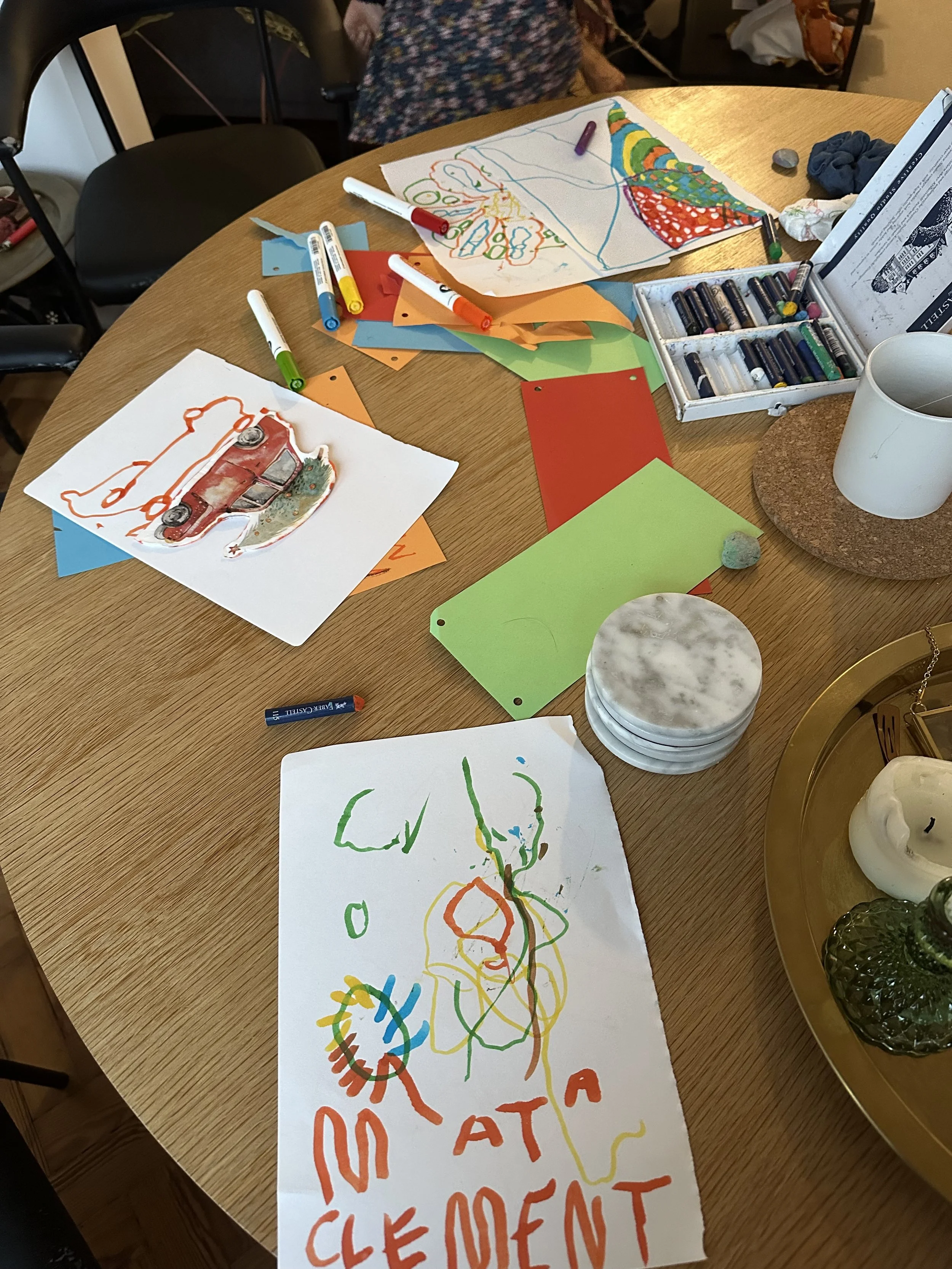
I brought paper.
Then pens.
Then colors.
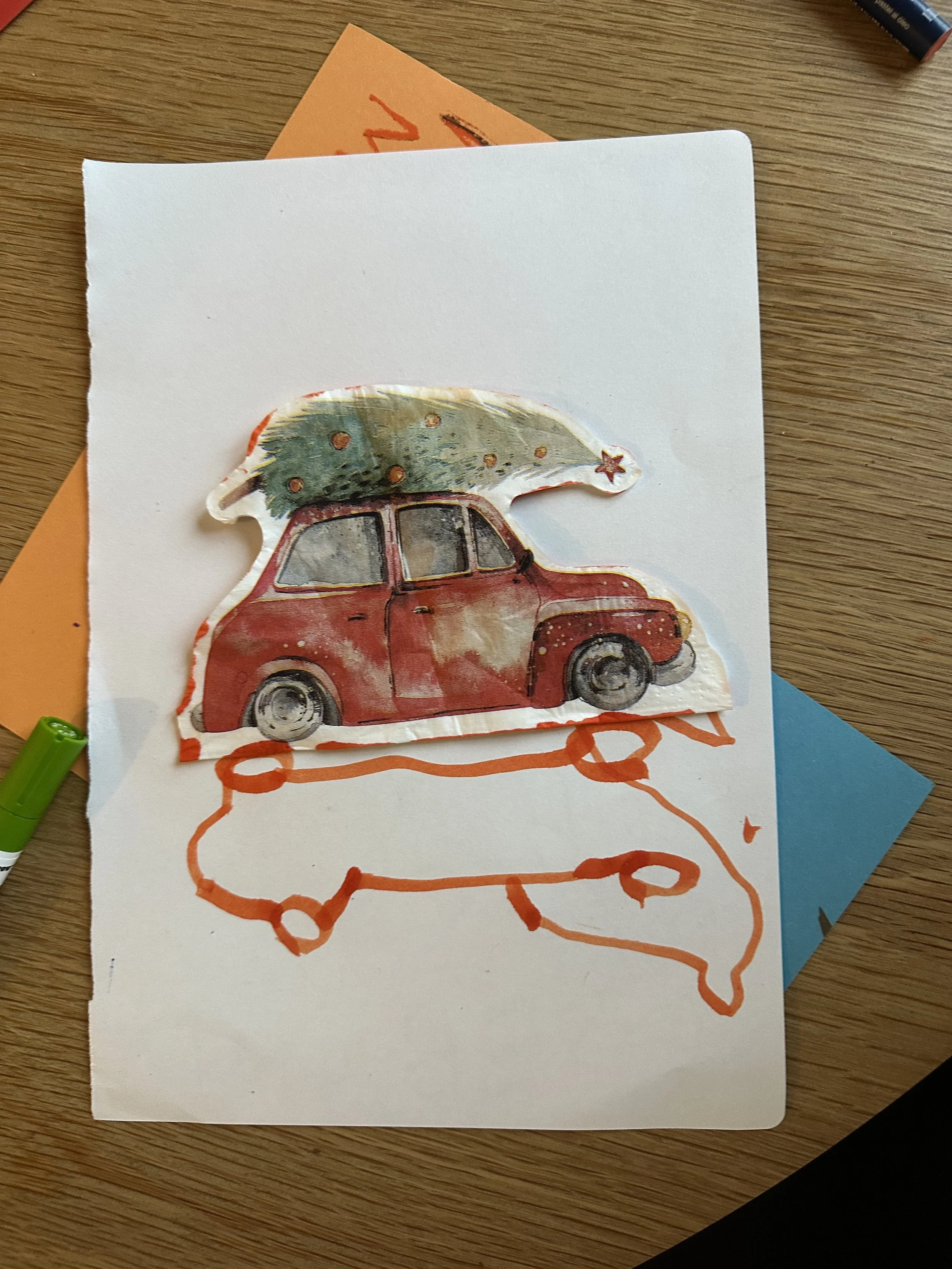
Then scissors and glue.
One by one. Slowly.
Only adding tools when I felt they were ready.
And something remarkable happened.
Neurographic Art with Pebbles: A Quiet Transformation
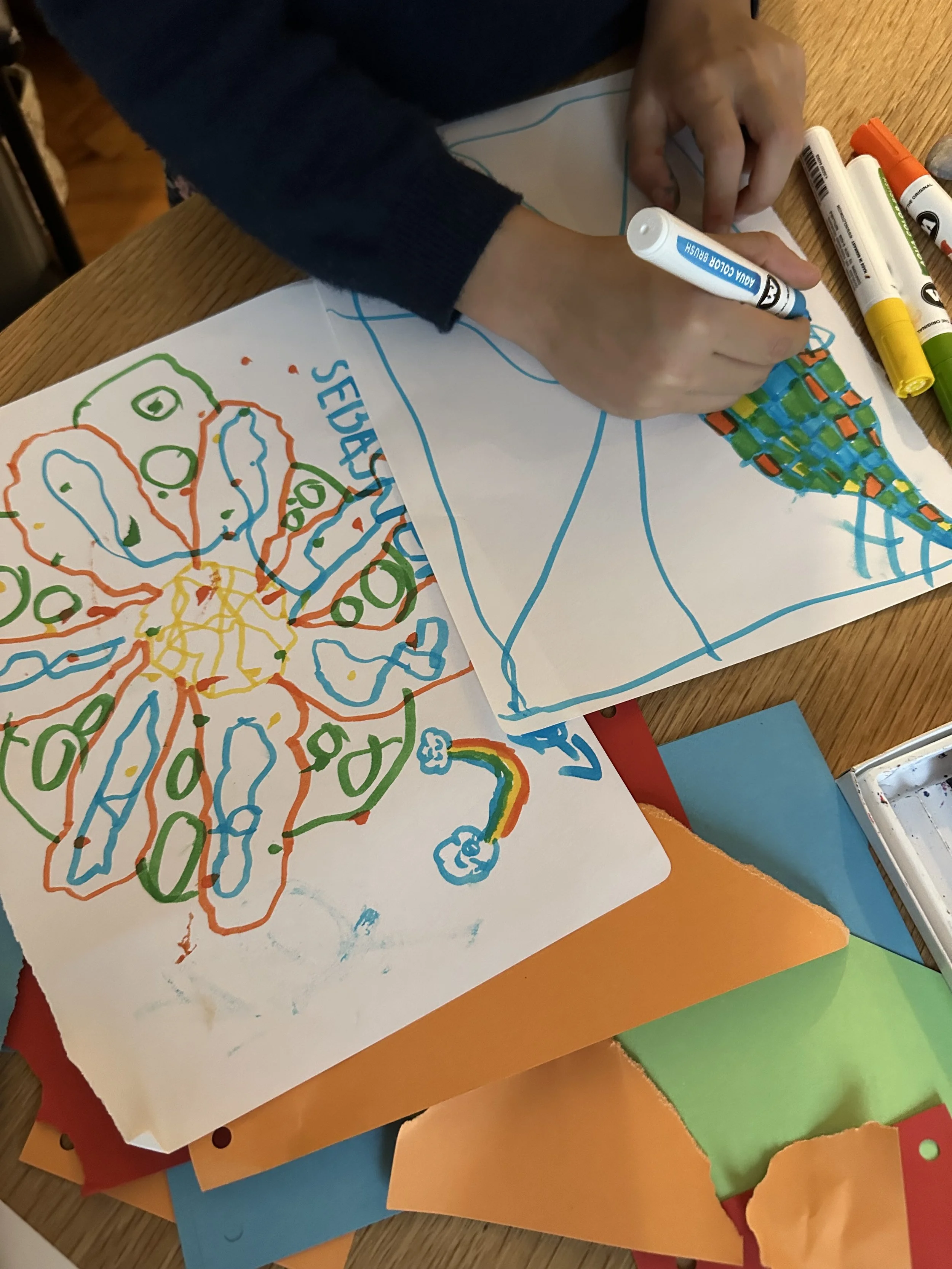
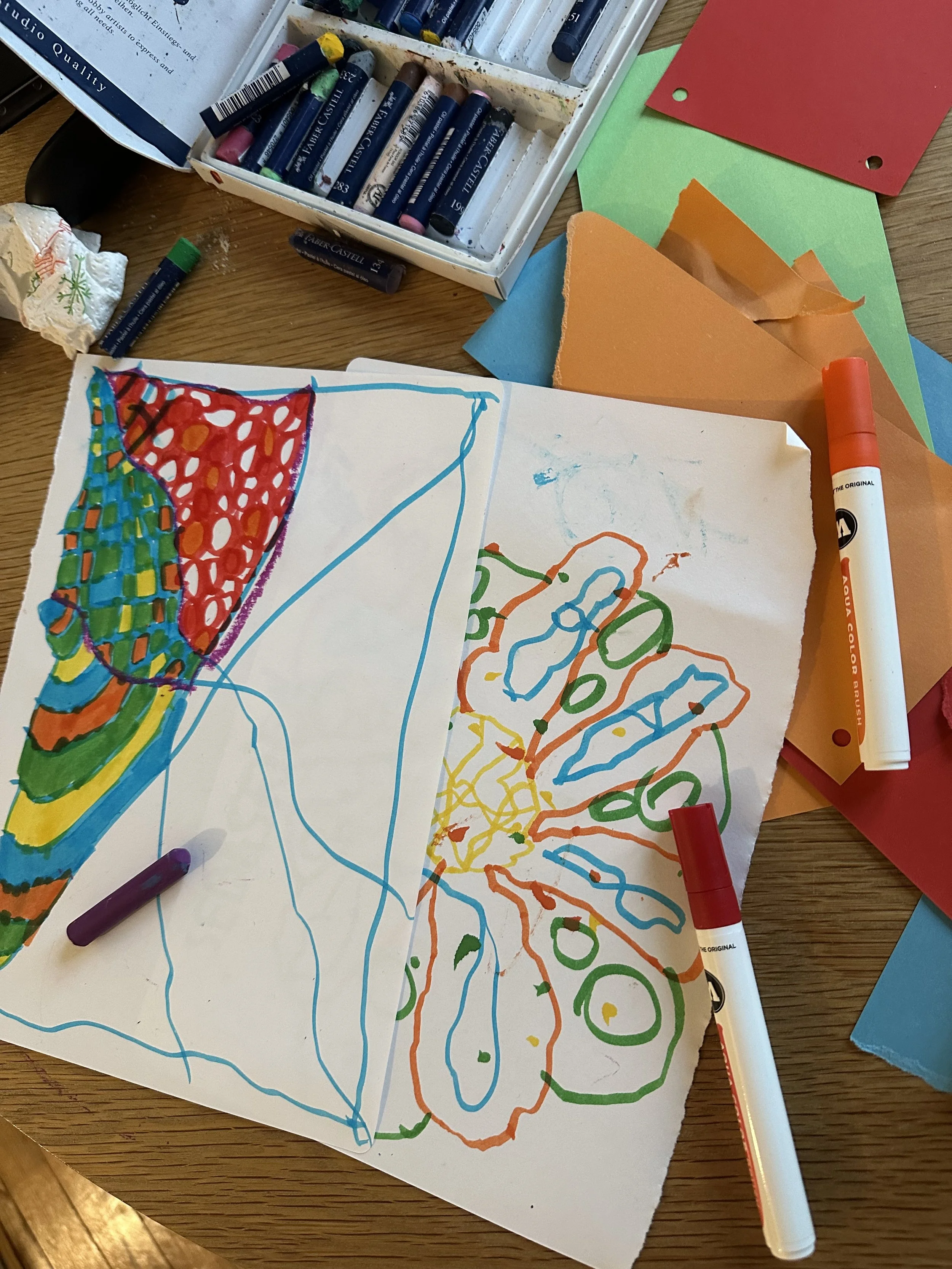
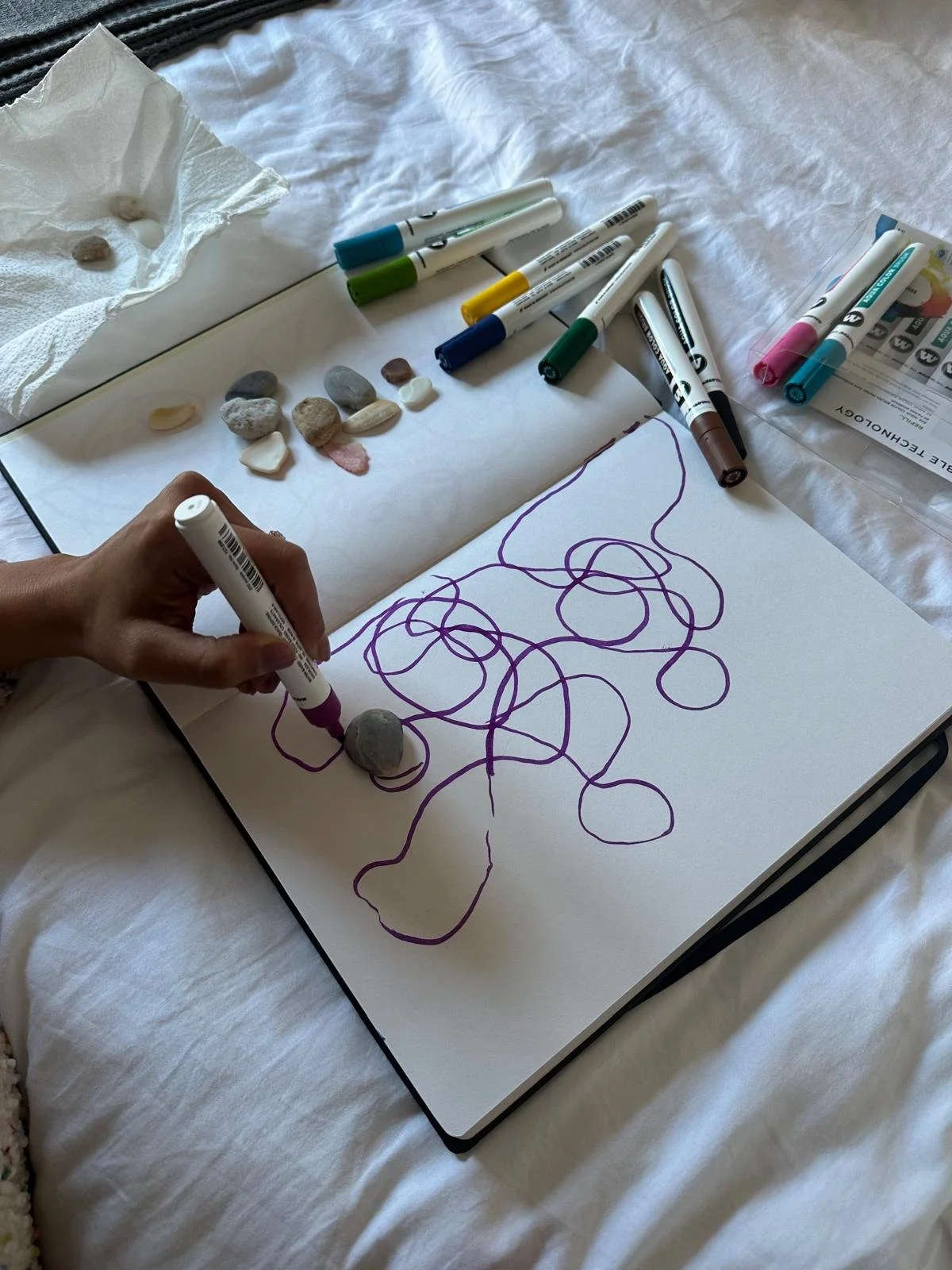
We began with neurographic art—a simple, flowing drawing practice that supports nervous system regulation and focus.
Each child chose two small pebbles.
One pebble was placed in front of the pen.
The rule was simple:
“The pebble must not leave the paper.
The table is lava.”
They guided their pens slowly around the stone, creating organic, flowing lines.
Then I invited them to draw a flower—or anything they wished.
What unfolded was a quiet journey.
The younger child followed his sister’s movements, learning, observing, refining his coordination.
The older child naturally stepped into her role—confident, expressive, creative.
They created artworks and small gifts for their parents.
Each piece meaningful. Each one intentional.
The room was still filled with joy and giggles—but without agitation.
Without competition.
Without frustration.
Focused. Grounded. Alive.
Why Art Therapy Is So Powerful for Young Children
Art therapy for children is not about producing “beautiful” art.
It is about:
regulating the nervous system
expressing emotions beyond words
integrating movement, imagination, and feeling
For children as young as 4 years old, art therapy supports:
fine motor development
sensory integration
emotional expression
attention and self-regulation
For children around 7 years old, often just entering school—their first institutional environment—creative spaces become even more essential.
At this age, children begin to:
adapt to external structures
meet expectations
experience comparison and performance
Art offers a counterbalance.
A space where process matters more than outcome.
Neurographic art, in particular, supports:
calming repetitive movement
bilateral brain integration
confidence through flow rather than control
Adding natural elements like pebbles enhances grounding and sensory awareness—bringing the body back into the experience.
Try This at Home: Neurographic Art for Children (Ages 4–8)
You don’t need to be an artist—or a therapist—to offer your child a calming, creative experience at home.
This simple neurographic art practice supports focus, emotional regulation, and creativity, especially after screen time or during high-energy moments.
What This Day Taught Me
Children do not need more stimulation.
They need meaningful engagement.
Art does not suppress their energy—it organizes it.
It does not calm by force—it regulates through joy.
What I once feared would be “too much” for them
became exactly what they needed.
And perhaps—what many of us adults need, too.
Soul Veda Reflection
At Soul Veda, art is not a technique.
It is a language.
A way to listen, regulate, express, and belong—at any age.
If you are curious about art therapy for children or as a family, creative rituals, or embodied alternatives to screen time, you are warmly invited to explore this path with me—through workshops, sessions, or shared practice.
Because healing often begins where play, presence, and creativity meet.
Book a free 30 min call with me