


A Modern Guide to Healing Mind, Body & Creativity
If you try to understand Ayurveda today, you might quickly feel overwhelmed.
Everywhere you look, Ayurveda seems to have become a product.
Ayurvedic skin creams promising eternal youth.
Ayurvedic detox retreats after weeks of wine, sugar, and stress.
Ayurvedic diets promising the perfect slim body.
Ayurvedic massages to remove wrinkles, cellulite, and fatigue.
None of these things are wrong. Many of them can be beautiful and beneficial.
But they are only fragments of something far deeper.
Ayurveda was never meant to be a quick remedy for modern excess.
It was never meant to be something we visit once a year at a spa.
Ayurveda is a way of understanding life itself.
It is a system of medicine, psychology, philosophy, and daily living that has been practiced in India for thousands of years — woven into cooking, rituals, family traditions, prayer, healing, and community.
In its truest form, Ayurveda therapy is not simply about fixing symptoms.
It is about restoring harmony between body, mind, environment, and purpose.
Or as the Charaka Samhita, one of Ayurveda’s foundational texts, beautifully states:
“Health is the equilibrium of doshas, digestive fire, tissues, and elimination — together with a balanced mind, senses, and spirit.”
— Charaka Samhita, Sutrasthana 9
This definition alone tells us something important: Ayurveda never separated physical health from emotional and spiritual wellbeing.
Everything belongs together.
The True Meaning of Ayurveda
The word Ayurveda comes from Sanskrit:
- Ayus — life
- Veda — knowledge or wisdom
Ayurveda therefore means:
“The knowledge of life.”
It is often described as the oldest continuously practiced system of medicine in the world, with roots reaching back more than 5,000 years into the Vedic traditions of India.
But Ayurveda was never only about medicine.
It was about understanding how to live well.
The ancient sages observed nature carefully. They noticed that the same elements that shape the world — earth, water, fire, air, and space — also shape the human body and mind.
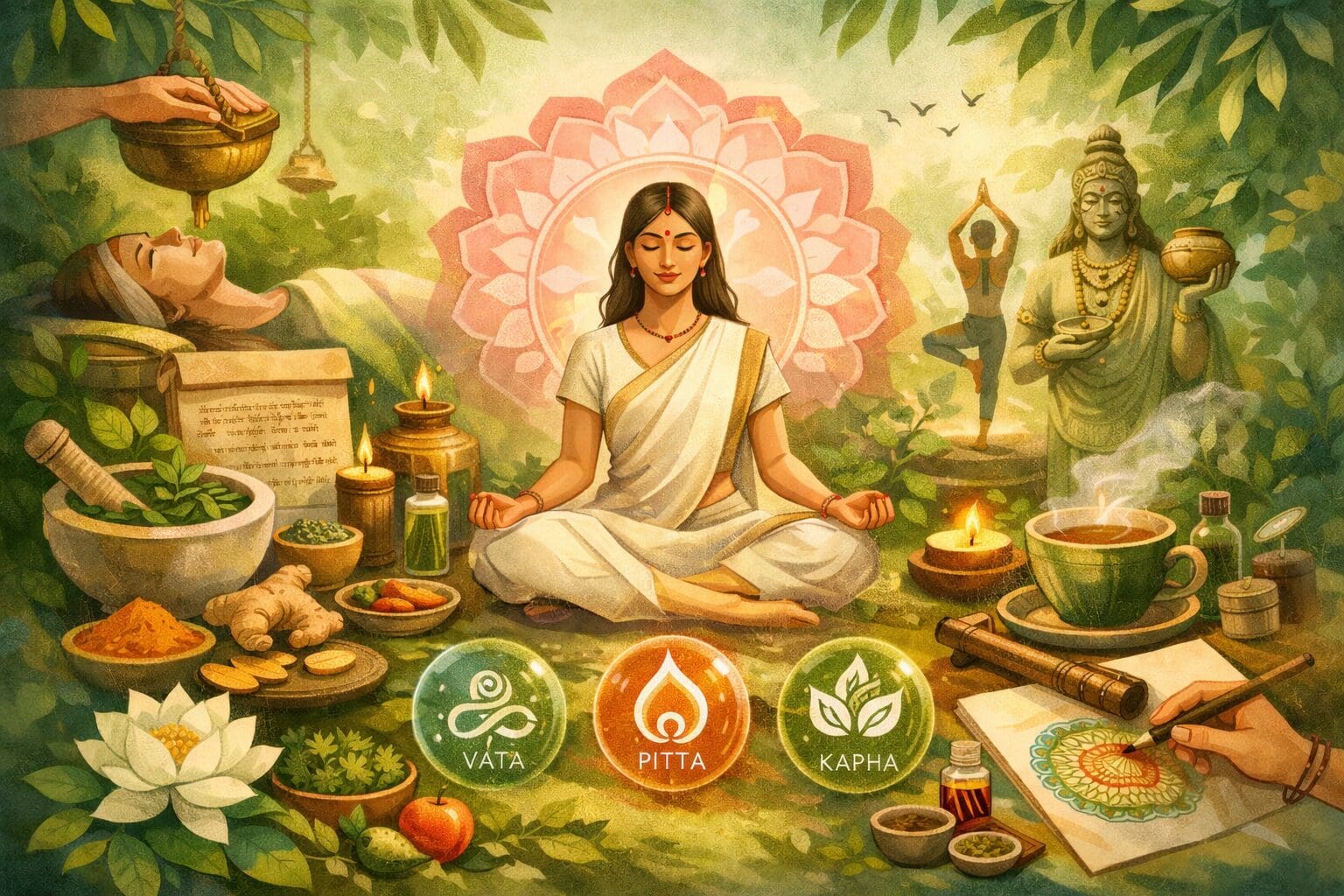
From these elements arise the three doshas:
- Vata (air + space) — movement, creativity, nervous system
- Pitta (fire + water) — metabolism, digestion, transformation
- Kapha (earth + water) — stability, structure, immunity
Every person is born with a unique balance of these energies. This is called your Prakriti — your natural constitution.
Over time, stress, lifestyle, environment, diet, emotional patterns, and modern habits can disturb this balance. This disturbance is called Vikriti.
Ayurveda therapy always begins here.
Not with a product.
Not with a detox.
But with understanding the person.
Ayurveda Therapy Begins With Understanding Your Dosha

Authentic Ayurveda therapy always starts with a personal assessment.
Before recommending herbs, nutrition, or treatments, an Ayurvedic practitioner seeks to understand:
- your Prakriti (your natural constitution)
- your Vikriti (current imbalance)
- your digestion and metabolism
- your sleep and emotional patterns
- your lifestyle and environment
- your mental tendencies and energy
In traditional Ayurveda clinics in India, this assessment may include:
- pulse diagnosis
- tongue observation
- digestive assessment
- lifestyle and mental state evaluation
Only after this understanding can therapy begin.
Because Ayurveda recognizes something very simple yet profound:
What heals one person may disturb another.
Ayurveda Therapy Is Not Only Detox and Massage
In the West, Ayurveda therapy is often associated with detox retreats and luxurious treatments.
These can indeed be powerful. Classical Panchakarma, for example, is one of Ayurveda’s most profound detoxification systems, designed to remove deep toxins (ama) from the body.
It may include therapies such as:
- Abhyanga (warm oil massage)
- Shirodhara (oil poured gently over the forehead)
- Nasya (nasal therapy)
- Basti (medicated enemas)
- Internal cleansing protocols
But in India, Ayurveda is not something people do once a year.
It is something they live every day.
Through simple rituals that quietly support health.
Everyday Ayurveda: The Rituals of Daily Life
Many Ayurvedic practices are so ordinary in Indian households that people may not even think of them as “therapy”.
Yet they support health in profound ways.
Simple examples that I have grown up with since my existence include:
Never leaving the house with wet hair
In Ayurveda, the head is considered a sensitive area where cold and wind can disturb Vata.
Regular oiling of the scalp and hair
Warm oils nourish the nervous system and calm the mind.
Drinking warm water in the morning
To stimulate digestion and gently awaken the body.
Using ghee in daily cooking
Ghee supports digestion, lubricates tissues, and nourishes the brain.
Avoiding cold milk or incompatible food combinations
Certain food pairings are believed to disturb digestion and create toxins.
Eating freshly cooked meals
Food is considered living energy (prana), best consumed when fresh.
These habits are not strict rules.
They are small acts of self-respect toward the body.
Ayurveda Is Also a Psychology
One of the most beautiful aspects of Ayurveda is that it never separated physical health from mental patterns.
The ancient texts describe not only bodily diseases but also emotional states such as:
- fear
- anger
- attachment
- grief
- confusion
The Charaka Samhita reminds us:
“One who understands the proper use of diet, sleep, and disciplined living will avoid disease.”
— Charaka Samhita
Mental balance, lifestyle, and emotional awareness were always considered central to healing.
This is why Ayurveda traditionally included practices such as:
- meditation
- yoga
- mantra chanting
- prayer
- reflection
- storytelling and philosophy
These were not spiritual luxuries.
They were part of mental health care.
Ayurveda, Mythology and the Human Mind
Ayurveda grew from the same philosophical roots as the Vedas and ancient Indian mythology.
Stories were used as mirrors of the human psyche.
One famous example is the churning of the cosmic ocean.
In this story, gods and demons churn the ocean of existence to obtain the nectar of immortality.
But before the nectar appears, poison rises to the surface.
In Ayurveda, this metaphor reflects our own healing process.
When we begin to detox — physically or emotionally — the first things that arise are often discomfort, old memories, toxins, or suppressed emotions.
Healing is not always smooth.
It requires churning the ocean within ourselves.
Can Creative Therapy Be Part of Ayurveda?
In the classical Ayurvedic texts, healing was never limited to herbs or diet.
Ayurveda recognized that the mind influences the body deeply.
Creative expression — painting, storytelling, music, movement — allows emotions and subconscious patterns to surface in a safe way.
Modern neuroscience now confirms what ancient traditions already knew:
Creative activity can regulate the nervous system, release emotional tension, and improve mental wellbeing.
In this sense, creative therapy naturally complements Ayurveda.
Through therapeutic art practices, individuals can:
- process emotional patterns
- release inner blockages
- reconnect with intuition
- calm the nervous system
- cultivate mindfulness
This is the philosophy behind Mantra Art and therapeutic creativity, where meditation, storytelling, and artistic expression become tools for inner healing.
Creativity becomes a bridge between ancient wisdom and modern psychology.
Ayurveda Is Not About Perfection
One of the biggest misunderstandings about Ayurveda is the idea that it requires perfect discipline.
In truth, Ayurveda speaks much more about balance and awareness.
It recognizes that life moves in cycles.
Sometimes we are stable.
Sometimes we are overwhelmed.
Sometimes we are exhausted.
Ayurveda does not ask for perfection.
It asks for awareness.
What nourishes you?
What depletes you?
What habits support your long-term wellbeing?
Or as the Charaka Samhita reminds us:
“He who lives with awareness of time, place, and his own nature remains healthy.”
Ayurveda Therapy as a Living Practice
True Ayurveda therapy is therefore not a single treatment.
It is a living relationship with your body and mind.
It may include:
- personalized nutrition
- herbal support
- detoxification treatments
- yoga and breathwork
- meditation and mantra
- daily rituals
- emotional and psychological work
- creative expression
All guided by a simple principle:
Understanding yourself deeply.
Because healing is not something we purchase.
It is something we practice.
A Return to Balance
In a world that constantly pushes us toward excess — more stimulation, more productivity, more consumption — Ayurveda quietly invites us back to something much simpler.
Balance.
Rhythm.
Awareness.
Not through strict rules, but through daily acts of care.
Through cooking nourishing meals.
Through rituals that calm the mind.
Through creativity that allows emotions to move.
Through understanding our own nature.
And perhaps this is the real power of Ayurveda therapy.
Not that it promises a perfect body or a flawless life.
But that it teaches us how to live with ourselves in a more conscious way.
If you would like to explore Ayurveda therapy more deeply — through dosha assessment, nutrition guidance, creative healing practices, or therapeutic workshops — you can learn more at:
Where ancient wisdom meets modern healing.

