


On a random day in Japan perhaps almost 13 years ago I came across a word that stopped me: Ikigai. It was the closest concept to Dharma I had ever encountered outside of it, and the first time I understood the idea of purpose in a non-mythological way – stripped of gods, empires, and moral battlefields – reduced to one disarmingly simple question: what is the reason you get up in the morning?
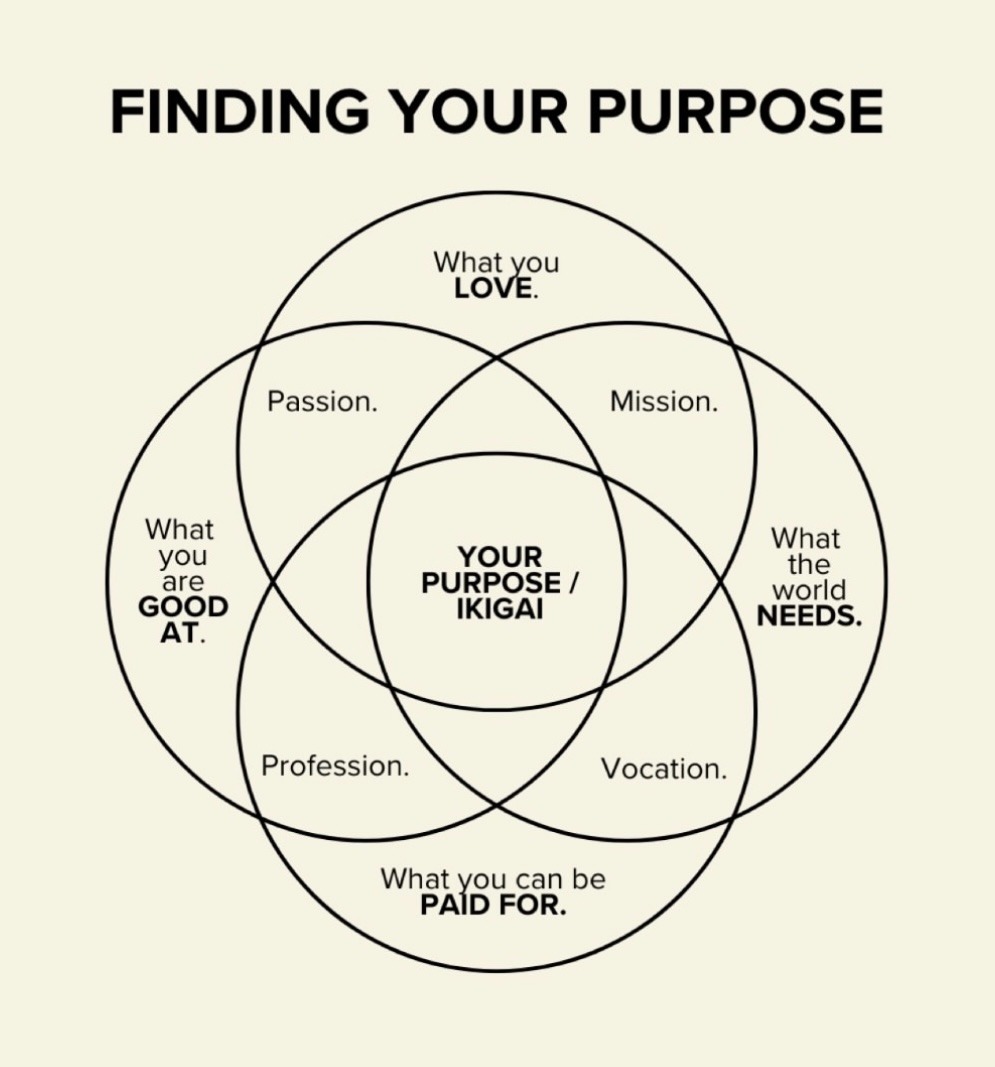
I have seen a version of that question more times than I can count since – usually not asked so plainly, but folded into a tidy four-circle diagram that travels the internet under the same word I’d first heard in Japan. The questions it asks are real. The diagram that asks them, and the word it borrows to do so, and the people who use it (often corporate leadership which wants to sound more wholesome) and the reasons they use it (for more resilience and productivity) is not quite telling the whole story. And this builds a lot of tension in myself and makes me cringe.
This article is for the people who keep meeting that diagram and feeling both drawn to it and vaguely failed by it. The ones standing at the edge of a career change, unsure which way to jump. The ones coming back from burnout, relearning how to want things. The young adults being asked, at twenty-two, to already know what they’re “meant” to do. And the ones on the other side of life – who raised the children or built the business, and are now standing in a suddenly quiet house asking, with real vertigo: what now?
I want to take that diagram apart gently, trace it back to where it actually came from, and then walk somewhere older – into the Vedic philosophy that underlies Ayurveda, where this same question has been asked, and answered rather differently, for thousands of years. Because Ayurveda has an answer here that most practitioners never touch. We are very comfortable talking about your Agni, your Doshas, your diet. We are far less comfortable talking about your mind and your soul – the part of Ayurveda that deals with why you feel so lost in the first place.
The Diagram We All Know – But Nobody in Japan Invented
Let’s start with an honest correction, because it changes everything that follows.
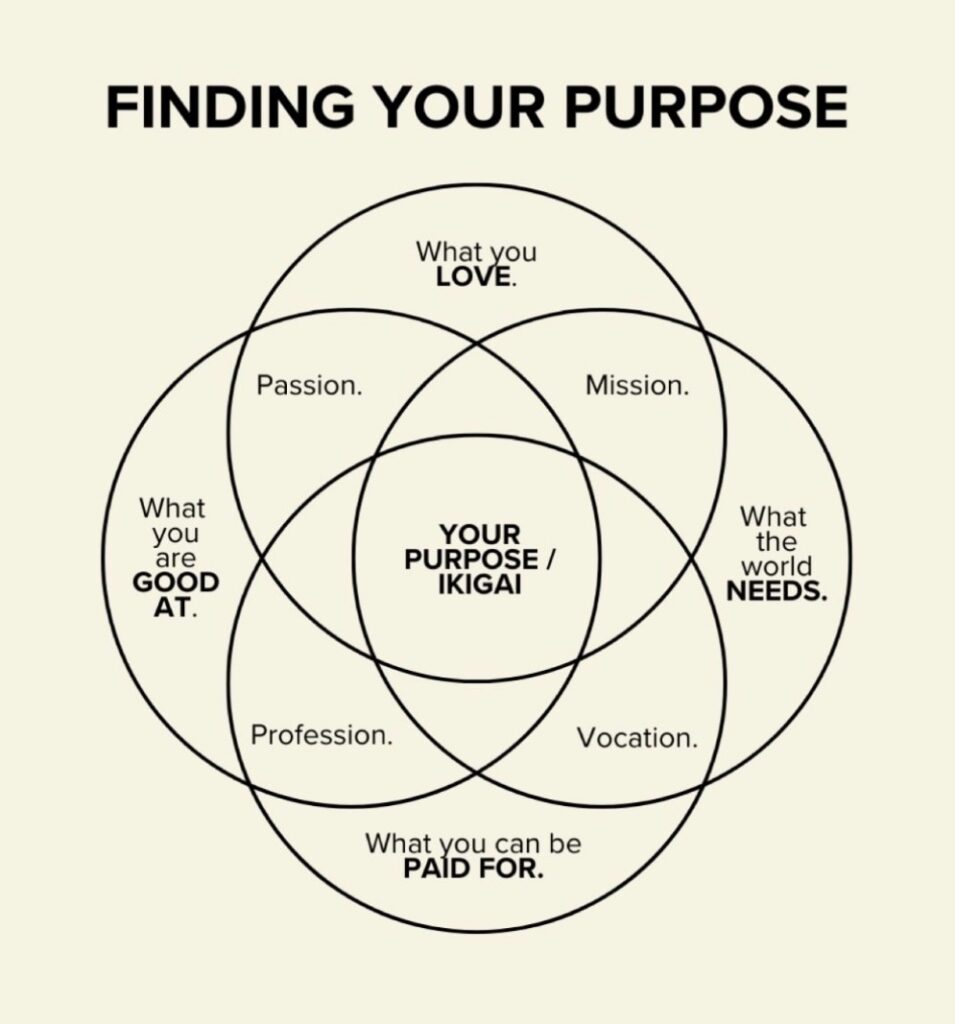
The four-circle “Ikigai” diagram was not born in Japan – and it has two separate parents, not one. In 2009, the National Geographic explorer Dan Buettner gave a TED talk on the “Blue Zones”, the handful of regions in the world with unusually high numbers of centenarians, Okinawa among them. It was Buettner, introducing Okinawan culture to a Western audience, who first popularised the translation now permanently attached to the word: “the reason for which I wake up in the morning.” Five years later, in 2014, a British blogger named Marc Winn watched that talk and merged it with a completely unrelated framework – a purpose “flower” diagram created by the Spanish astrologer and consultant Andrés Zuzunaga – producing the four overlapping circles that now circulate under the ikigai name. Neither the diagram nor the pairing of that diagram with the word ikigai originated in Japan – a fact Wikipedia itself now flags in its own entry on the term.
So what does ikigai actually mean? The word is a compound of iki, to live or be alive, and gai, worth or value – together, something closer to “a reason for being” than “purpose” in the ambitious, career-planning sense we’ve built around it in the West. It is not, traditionally, a grand singular calling sitting at the crossing point of four near-impossible conditions. For many people in Japan, ikigai is plural and ordinary rather than singular and grand – a morning ritual, a grandchild’s visit, tending a garden, the quiet satisfaction of a well-practised craft.
The Venn diagram insists ikigai must sit at the intersection of everything – what you love, what the world needs, what you’re good at, what you’re paid for – when in reality most of the time something you love but will never be paid for, or something you’re not particularly skilled at, can absolutely still be your ikigai.
Let this sink for a while…
I find this correction strongly moving and warning us, because it means the diagram – and plenty of other useful frameworks that are invented recently – makes purpose sound like a business plan. It asks you to optimise your way into meaning. And if you have ever tried to optimise your way into feeling like your life makes sense, you already know how that goes.
Not well…
An Older Word for the Same Question: Dharma
Long before Okinawa, long before TED talks and LinkedIn, the Vedic tradition of India was asking the same underlying question – and it gave the answer a different name: Dharma.
Dharma is one of those Sanskrit words that resists a single English translation, and I’d rather leave it slightly untranslatable than flatten it into “duty” or “religion,” which is how it’s often rendered and how much of its depth gets lost. Dharma comes from a root meaning “to hold” or “to sustain” – it is that which upholds you, and which you in turn uphold. It is not just what you do. It is the right, natural expression of who you are, given your nature, your circumstances, and the season of life you are standing in.
The Bhagavad Gita – arguably the most influential meditation on purpose in the entire Vedic canon – puts it with a sharpness that still lands today: it is better to walk your own dharma imperfectly than to perform someone else’s flawlessly. Your svadharma – your own dharma – will always outrank paradharma, someone else’s dharma borrowed and worn like a costume. This is, I think, the exact trap the four-circle diagram sets without meaning to: it quietly asks you to find the one universal formula, as though purpose were the same shape for everybody. Dharma insists on the opposite. Your dharma is legitimately, structurally different from mine.
Put ikigai and dharma side by side and you get something rather beautiful. Ikigai, in its authentic form, is humble and daily – the reason you get up this particular morning. Dharma is structural and ethical – the right alignment between your nature and your role, one that shifts as your role shifts. Neither is a job title. Both insist that purpose is a relationship you keep renewing, not a discovery you make once and file away.
The Missing Third Pillar: Why Ayurveda Isn’t Just About the Body
Here is where I want to bring in the part of my own field that gets left out constantly – including, if I’m honest, by many Ayurvedic practitioners themselves.
Ask most people what Ayurveda is, and you’ll hear: herbs, oil massage, maybe turmeric, maybe a strict diet based on your Dosha. All true. All real. And all only one-third of the picture. Classical Ayurveda was never only a system of physical medicine. Its own foundational definition of health includes the mind and the soul as equal partners to the body – a state in which the senses, the mind, and the deeper self all rest in a kind of settled clarity together, not just a body free of physical disease.
This is where two Sanskrit concepts become essential: Manas, the mind, and Atman, the soul or seat of consciousness. Ayurveda maps the qualities of the mind through three Gunas – Sattva, Rajas, and Tamas. Sattva is clarity, balance, and lucid awareness. Rajas is activity, restlessness, ambition, desire – the accelerator. Tamas is inertia, heaviness, numbness, avoidance – the anchor dragging on the seabed. A healthy mind moves fluidly and mostly rests in Sattva. A mind under chronic strain gets pulled to one of the extremes: too much Rajas, or, once that burns itself out, too much Tamas.
I don’t think I need to describe modern life to you in detail for you to recognise this pattern immediately. A world of constant competition, of endlessly refreshing content, of new trends every week, of automation and AI reorganising entire careers overnight, of career pressure and financial pressure and family obligation stacked on top of each other – this is a near-perfect machine for generating excess Rajas. We are agitated, overstimulated, reactive, chasing. And when the body and mind can no longer sustain that pace, they don’t return gently to balance. They collapse into Tamas – the fog, the flatness, the “I don’t even know what I want anymore” of burnout. This is precisely the arc I see again and again in clients recovering from chronic fatigue, Long Covid, and burnout: years of Rajasic overdrive followed by a Tamasic crash so total it can feel like losing yourself.
And underneath both extremes sits the actual casualty: Sattva – the very quality of mind you need in order to hear your own dharma at all. You cannot locate your purpose from inside a nervous system in overdrive, and you cannot locate it from inside a nervous system in shutdown. This is not a metaphor. It is, quite literally, why so many capable, accomplished people reach a point of total disconnection from their own sense of direction. It was never missing. It became inaudible.
Ayurveda actually has a formal branch of psychotherapy for exactly this – Sattvavajaya Chikitsa, sometimes translated as “the therapy of mental restraint” or “victory of Sattva.” Its literal meaning is the withdrawal of the mind from what is unwholesome, restoring the balance between Sattva, Rajas, and Tamas through self-knowledge, ethical reflection, patience, memory, and meditation. Classical Ayurveda essentially describes this as a form of counselling and cognitive re-patterning that predates modern psychotherapy by well over a thousand years – not unlike aspects of cognitive behavioural therapy, but with an explicitly spiritual dimension woven through it, because Ayurveda never separated the mind from the soul in the first place.
I understand completely why this side of Ayurveda is underused. Working with someone’s Doshas, their diet, their Agni – that is comparatively contained work. The moment you step into Manas and Atman, into someone’s actual relationship with meaning, you are doing something closer to psychotherapy than to nutrition counselling, and it demands a different kind of training and a different kind of presence. But this is also, I’d argue, where the real healing of our modern disconnection has to happen. You cannot herb your way out of a purpose crisis.
Why the Purpose Question Hits Differently at Different Ages
If you are in the middle of a career change, recovering from burnout, twenty-something and being asked to already know your calling, or newly retired and quietly disoriented – I want to say clearly: you are not confused because something is wrong with you. You are meeting an old and completely legitimate threshold, one the Vedic tradition mapped out explicitly, thousands of years before anyone called it an “existential crisis.”
The young person facing this question for the first time is often trying to answer it with borrowed material – parental expectation, a trending career path, an algorithm’s suggestion of what’s viable – rather than from any real contact with their own nature, their own Prakriti. The person leaving a burnout is often trying to answer it from a mind still deep in Tamas, expecting clarity to arrive before the ground has even stabilised, which is a bit like asking someone to read fine print in the middle of a storm. And the person entering retirement, or watching the last child leave home, is often grieving a dharma that was real and valuable – and has now, quite legitimately, ended – while mistaking that ending for the disappearance of purpose itself.
That last one deserves its own space, because Ayurveda and the Vedic tradition planned for it explicitly.
Purpose Is Allowed to Change: The Four Ashramas
The Vedic life-map divides a lifetime into four stages, or Ashramas, each with its own legitimate dharma. This isn’t a rigid, outdated rulebook I’m asking you to follow literally – some of it clearly reflects a very different society than the one we live in now. But as a framework for understanding that your purpose is supposed to change shape as your life does, it is remarkably precise.
Brahmacharya – roughly, the student stage. The dharma here is learning: building character, discipline, and the raw skills and self-knowledge you will draw on for the rest of your life. In modern terms, this can stretch well past formal education – it’s any period where your primary task is becoming, not yet producing.
Grihastha – the householder stage, traditionally the longest and, in Vedic thought, the one that quietly supports all the others. The dharma here is building: career, family, income, contribution to your community. This is the stage most of the “finding your purpose” content on Instagram is unconsciously written for – and it is precisely why it feels so wrong when you’re not in it.
Vanaprastha – a gradual, deliberate stepping back. Traditionally, this begins once the responsibilities of the householder stage have been fulfilled – children grown, obligations honoured – and it is the stage of handing over, mentoring, reflecting, moving from the centre of the household to its side. This is, almost precisely, the retirement and empty-nest transition so many of my clients arrive describing as a loss, when the Vedic tradition frames it as a promotion into a different, quieter kind of dharma.
Sannyasa — full renunciation and inward turning, traditionally the final stage, oriented entirely toward meaning beyond material and social roles.
| Ashrama | Traditional Focus | Modern Parallel |
| Brahmacharya | Learning, discipline, self-formation | Education, early career, any period of active becoming |
| Grihastha | Householder — career, family, contribution | Building a career, raising a family, active midlife |
| Vanaprastha | Gradual withdrawal, mentorship, reflection | Retirement, empty nest, career winding-down |
| Sannyasa | Full renunciation, inward focus | Late-life turn toward meaning, legacy, spirit |
Read this way, the retiree’s “what now?” is not a crisis of purposelessness. It is the entirely predictable, entirely honourable arrival of Vanaprastha – a dharma that looks completely different from Grihastha because it is supposed to. And the twenty-two-year-old who doesn’t yet know their calling isn’t behind. They’re standing, appropriately, in Brahmacharya, where the actual task is not to have the answer yet, but to become someone capable of finding it later.
The Cultural Onion: Why the Core Stays the Same Even When the Role Doesn’t
So if purpose legitimately changes shape across a lifetime, what stays constant? This is where I find it useful to borrow a framework from well outside Ayurveda entirely: Geert Hofstede’s Cultural Onion.
Hofstede introduced the model in 1991 to explain a simple but easily missed distinction: the difference between what a culture visibly does and what it actually believes. He described culture as a series of layers, arranged like an onion, running from the outermost layer – the fastest to change, the easiest for an outsider to observe – down to a core that barely moves across an entire lifetime. Picture four concentric rings.
Symbols sit on the outside. These are words, gestures, images, objects, and brands that carry a specific meaning within a culture – the ones outsiders can see immediately but rarely understand. On a personal level, this is your job title, your wardrobe, the language and slang you use, the platforms you’re on, the trends you follow this year and will likely have forgotten by next year. Symbols are cheap to change and we change them constantly.
Heroes are the next layer in. These are real or fictional people who possess qualities a culture prizes highly, and who quietly serve as behavioural models – consciously chosen or not. Nationally, this might be a historical figure or a celebrity. Personally, it’s who you looked up to at fifteen versus who you look up to now: a parent, a mentor, an author, an influencer, a public figure whose way of living you’ve been unconsciously measuring yourself against. Heroes shift more slowly than symbols, but they do shift – often exactly at the point where one life stage gives way to another.
Rituals are the layer after that: collective or personal activities that are, strictly speaking, unnecessary to achieve their stated purpose, but which a culture treats as essential anyway, and performs for their own sake. Ways of greeting people, the shape of a morning, how you mark an ending or a beginning, how you observe a meal. This is the layer where Dinacharya – Ayurveda’s daily rhythm – actually lives. Rituals change slowly, and disrupting them, even briefly, tends to produce a disproportionate sense of disorientation, which is itself a clue to how much quiet structural weight they carry.
And at the very centre, largely invisible even to the person carrying it, sits the core: values. Hofstede described values as broad, mostly unconscious preferences for certain states of affairs over others – ideas about what is good, safe, desirable, or forbidden, absorbed so early in life that most people can’t recall learning them at all. Symbols, heroes, and rituals can all be observed from the outside. Values can only be inferred, by watching what a person consistently protects, chooses, or refuses, layer after layer, over years.
| Layer | What It Is | Pace of Change | Personal Example |
| Symbols | Words, objects, images, brands, trends | Fastest — changes with fashion | Job title, wardrobe, the apps you use |
| Heroes | Real or fictional people who model admired traits | Shifts across life stages | Who you looked up to at twenty vs. now |
| Rituals | Collective or personal practices, felt as essential | Slow, gradual | Your morning routine, your Dinacharya |
| Values | Unconscious beliefs about what matters | Nearly static across a lifetime | Honesty, care for others, autonomy |
Applied to a single life rather than a whole culture, the onion becomes a strikingly precise tool for understanding why purpose can look so different from one decade to the next without actually being lost. This is precisely why purpose can change shape at every Ashrama without actually being lost. The symbols, heroes, and rituals of Brahmacharya, Grihastha, Vanaprastha, and Sannyasa are entirely different from one another – that’s the whole point of the system. But the core, in Vedic terms your Atman and your Svabhava, your essential, unrepeatable nature, is the one layer that was never supposed to change. Your Ayurvedic Prakriti – the constitutional blueprint you were born with – is a physical expression of that same continuity: it doesn’t reset when your job title does. What does shift constantly is your Vikriti – your current state of imbalance – which is exactly why the same person can feel like an entirely different human being during a Rajasic year versus a Tamasic one, without their actual core values having moved an inch.
This is, I think, the real answer to the question underneath all of this. You are not required to find one purpose and hold it for sixty years. You are required to keep re-expressing the same core through whichever outer layer the current season of your life actually calls for – and to trust that the layer changing is not evidence that the centre was never there.
So How Do You Actually Find It? An Ayurvedic Way In
Not with a Venn diagram. This tends to unfold in two stages: an assessment that tells you where you’re standing, and a slower, ongoing piece of psychotherapeutic work that helps you actually stand there differently.
Step One: The Ayurvedic Assessment
Know your Prakriti before you try to fix anything. Your innate constitutional tendencies – how your mind naturally moves, how your energy is built, what genuinely nourishes versus depletes you – are not obstacles to your dharma. They are your first and most reliable clue to it.
Separate Vikriti from identity. If you currently feel numb, directionless, or wired and reactive, that is very likely a Rajas or Tamas imbalance speaking – a temporary state, not a verdict on who you are or what you’re for. Purpose work done from inside an unaddressed imbalance tends to produce more panic, not more clarity.
Rebuild Sattva before you go looking. This is the unglamorous, non-negotiable first step, and it is largely built through Dinacharya – consistent daily rhythm, sleep, digestion, movement, quiet. You cannot think your way to clarity from a dysregulated nervous system; you have to regulate first.
Locate your real Ashrama. Not the one you think you should be in, not the one your peers are in – the one you are actually standing in right now. A dharma borrowed from the wrong life stage will never quite fit, no matter how correct it looks from the outside.
An Ayurvedic assessment gives you this map: your Prakriti, your current Vikriti, and a clear read on where Rajas or Tamas has taken hold. But a map is a starting point, not the journey. It tells you where you are. It doesn’t, on its own, teach you how to keep finding your way back when life pulls you off course again – and it will.
Want to book an Assessment with me? Let’s talk!
Step Two: Ayurvedic Psychotherapy — Working the Gunas Through Dharma, Artha, and Kama
This is the part of Ayurveda I mentioned at the very start of this article – the one most practitioners leave out, because it takes real session-by-session work rather than a single reading. Once we know your Prakriti and Vikriti, the deeper work happens through Sattvavajaya Chikitsa: sitting with actual situations from your life, not abstractions, and slowly training the mind back toward Sattva by examining how Rajas or Tamas has been distorting it.
In practice, this means taking a real scene from your week – a decision you’re avoiding, a conversation you keep rehearsing, the job offer you can’t say yes or no to – and holding it up against three of the oldest organising principles in Vedic philosophy: the Purusharthas, the proper aims of a human life. Classical thought names four – Dharma, Artha, Kama, and, at the horizon, Moksha, liberation itself. In session work, it’s the first three that we live inside almost daily, and that’s where we spend our time together.
Dharma – your right action. Not duty in the guilt-laden sense the word often gets translated into, but the question of whether what you’re doing in this specific situation is actually yours to do, aligned with your nature and your current life stage, or whether it’s paradharma – someone else’s expectation you’ve been carrying as if it were your own. We look at whether Rajas has turned your sense of duty into compulsive over-functioning, or Tamas has turned it into passive avoidance, and where the honest, sustainable middle actually sits.
Artha – your resources. Not only money, though certainly money, but also time, energy, skill, health, and the relationships that support you. We look at your actual relationship to resource: is Artha driving you, pursued from a Rajasic scarcity or status anxiety that never feels like enough, or neglected altogether from a Tamasic reluctance to claim what you need? Purpose that ignores Artha collapses under its own weight; purpose that is only Artha becomes hollow.
Kama – your desire. Ayurveda has never asked you to suppress desire, only to understand it clearly. In session, we separate genuine desire – the things that reliably bring you alive – from performative desire, the wants that were installed by a trend, a comparison, or an old story about what you’re supposed to enjoy. A Rajasic mind often chases desire it doesn’t actually feel; a Tamasic mind often can’t locate desire at all. Both are treatable states, not permanent truths about you.
Held together, session after session, these three pillars stop being abstract Sanskrit terms and become a working lens: for any real situation in your life, is my action aligned (Dharma), am I resourced (Artha), and am I actually drawn toward this, or performing being drawn toward it (Kama)? Most of the disconnection I see in clients isn’t a mystery once it’s looked at this way – it’s usually one of these three quietly out of balance, dressed up as a bigger existential question than it needs to be.
This is, in practice, the full arc of the work I do with clients: an Ayurvedic assessment to read Prakriti and current Vikriti, followed by ongoing Sattvavajaya sessions that work the Gunas directly through real situations in your life – rather than a borrowed diagram trying to answer, once and for all, a question that was always meant to be revisited.
Also in Ayurveda we have a detailed framework of asking a set of questions to diving into Ayurvedic Psychotherapy with this.
I Don’t Think The Four-Circle Diagram Is Worthless
Somewhere between the Mahabharata and a quiet morning in Japan years later, I found my way to the same underlying question by two completely different routes. I don’t think the four-circle diagram is worthless, and I don’t think the epics were wasted on me either — they’re both at least pointing at the right question, even if neither one, on its own, was built to hold the whole answer. What you love, what you’re good at, what the world needs, what sustains you: these matter. They were just never meant to intersect neatly into a single tidy centre, discovered once and finished.
- Ikigai, in its true and older form, is closer to noticing what makes today worth getting up for.
- Dharma is the ongoing, evolving alignment between who you essentially are and the season you’re actually in.
- And Ayurveda — properly practised, mind and soul included, not just body — is one of the oldest maps we have for telling the two apart: for knowing which parts of you were built to change, and which parts were never supposed to move at all.
If you’re standing at one of these thresholds — leaving a career, leaving a burnout, leaving your twenties, or leaving an empty house — that’s not a sign you’ve lost your purpose. It’s a sign you’ve arrived at a new Ashrama, and it’s asking, quite reasonably, to be met on its own terms. I’d be glad to help you meet it, starting with an Ayurvedic assessment built around who you actually are, not a diagram built for everyone at once.
And if you’ve already done that work — if your body is steadier, your Dinacharya is holding, and the physical ground beneath you finally feels stable — that’s not the end of the path, it’s the doorway to the next stage of it. That steadiness is exactly what makes the deeper psychotherapeutic work possible. If you’re ready to go further, into the sessions where we actually sit with Dharma, Artha, and Kama and find your way back to what’s yours, I’d love to walk that stretch with you too.
Thanks for reading,
Mamta – Soul Veda, Art & Ayruveda Therapy

