


What pregnancy, iron deficiency and Ayurveda taught me about supplements, digestion and the difference between consuming a nutrient and actually receiving it
During my pregnancy, I have learned that my iron stores are extremely low.
This isn’t entirely surprising. Iron requirements increase significantly during pregnancy. The mother’s blood volume expands, while the placenta and growing baby also require iron. Iron deficiency and iron-deficiency anaemia are therefore particularly common during this time.
So I have started taking a prescribed iron supplement.
Every morning, first thing after waking, I take my iron tablet together with my prenatal supplements.
Shortly afterwards, I take my breakfast: muesli, yoghurt, fruit.
I thought this the right way.
But then I recently went back for another follow up blood test. And I was a little bit in shot.
Despite of taking my iron every single day, and not doing anything I thought could interfere with the treatment, my iron levels have dropped further, to an alarming level.
An honest confession, before the Ayurvedic one
I’ve written a lot on this platform about Ayurvedic routine — about warm food, about Agni, about eating in rhythm with the body’s digestive capacity. And for most of my adult life, that has genuinely been how I eat.
Pregnancy rearranged all of it.
Hormones don’t ask permission. They reach into mood, appetite, energy, and — as I’ve learned the hard way — into willpower itself. There are mornings when the idea of a warm, spiced, freshly cooked breakfast does not feel just unappealing but almost energetically impossible. The cold muesli with yoghurt and fruit is something that throughout the pregnancy seems the only constant that I like to eat. Repeatedly. Gratefully.
I say this not as a disclaimer but because I think it’s the more honest starting point for this article than pretending I approached my iron supplementation from some place of perfect Ayurvedic discipline. I didn’t. I approached it the way most of us approach supplements in a season of our lives when we are simply trying to function — grabbing what feels manageable, swallowing what we’re told to swallow, and hoping the rest takes care of itself.
But it didn’t.
About three months after starting the supplement, I repeated my blood tests. And I was shocked.
My ferritin had dropped from 19 ng/mL to just 12 ng/mL, while my haemoglobin had fallen from 11 to 10 g/dL.
To put those numbers into perspective:
- My laboratory considers ferritin below 30 ng/mL absolute iron deficiency, and its pregnancy-specific guidance flags ferritin below 70 ng/mL as iron deficiency.
- At 12 ng/mL, my iron stores were clearly depleted. My haemoglobin of 10 g/dL was also in the range generally described as mild anaemia during pregnancy.
And this was despite taking a therapeutic iron supplement every day for around three months.
Of course, this doesn’t prove I wasn’t absorbing my supplement at all. Pregnancy itself places enormous demands on maternal iron stores, and there can be many reasons iron levels don’t respond adequately to oral supplementation.
But it made me ask a question I had stopped asking since becoming pregnant and being on simple survival mode:
Was I taking my supplement in a way that allowed my body to absorb them well?
And what I learned surprised me — and, in a strange way, brought me back to Ayurveda even in a season when I felt furthest from living it properly.
Taking supplements is not the same as absorbing them
We talk a lot about what supplements to take. Much less about how and when to take them.
Iron absorption is influenced by what we consume around it. Calcium can interfere with it. So can phytates — naturally occurring compounds found in cereals, grains, legumes, nuts and seeds. Polyphenols in tea and coffee inhibit iron absorption too. Vitamin C, by contrast, enhances the absorption of non-haem iron.
A review in ACS Omega summarising the current evidence puts it plainly: dietary inhibitors such as calcium, phytates, and polyphenols, alongside enhancers such as ascorbic acid and proteins, meaningfully shape how much iron actually gets absorbed from a meal. On the calcium side specifically, research reviewed by the Iron Disorders Institute notes that calcium is the only known substance that inhibits absorption of both non-haem and haem iron, and that amounts in the 300–600 mg range — roughly what’s in a cup of milk — can meaningfully suppress it. Coffee and tea aren’t innocent either: a single cup of certain coffees can inhibit iron absorption by as much as 60%.
Vitamin C, meanwhile, does real physiological work. It doesn’t just sit alongside iron — it chelates and reduces ferric iron into the more soluble ferrous form, and actively counteracts inhibitors like phytates, polyphenols and dietary calcium.
Suddenly, I looked at my supposedly healthy morning routine differently:
Iron tablet. Prenatal supplements. Muesli. Yoghurt. Fruit.
The yoghurt provided calcium. The muesli contained grains, fibre and potentially substantial phytate. And depending on their formulation, prenatal supplements can themselves contain calcium, magnesium or zinc alongside iron — nutrients that compete for the same absorption pathways.
I had unknowingly surrounded my iron tablet with things that could make its absorption less favourable.
That doesn’t mean yoghurt or muesli are unhealthy. Quite the opposite. It means something more interesting:
A healthy food can still interact with a particular nutrient when consumed at a particular time.
Nobody had explained this to me when I was prescribed my iron. And in the fog of early pregnancy, eating whatever I could keep down, it genuinely hadn’t occurred to me to ask.
The forgotten dimension of supplements: timing
We’ve become accustomed to thinking about supplementation almost entirely in terms of dosage. Take one tablet daily. Take 400mg. Take your prenatal.
So we gather our supplements in the morning and swallow them together, because that’s the easiest way to remember them.
But nutrients don’t enter an empty biochemical vacuum. They encounter food, minerals, digestive secretions and other compounds — and those interactions shape bioavailability.
This doesn’t mean we need to become obsessive about supplement schedules. But in some circumstances, timing matters more than we’ve been told.
And this is where the research got genuinely surprising to me — because it turns out timing isn’t only about what else is on your plate. It’s about something happening inside the body, on a clock of its own.
Your body has its own digestive rhythm for iron — and it’s measurable
Here is the part of my research that stopped me in my tracks.
There’s a hormone called hepcidin that governs how much iron your intestine is willing to absorb at any given moment. When you take an iron dose, your body’s iron-sensing machinery responds by raising hepcidin — and elevated hepcidin actively blocks the absorption of iron from your next dose, for up to 48 hours.
In other words: taking iron today can measurably suppress your ability to absorb iron tomorrow.
A landmark study by Moretti and colleagues, published in Blood, tested this directly in iron-depleted women. They found that low-dose iron given on alternate days — rather than daily or twice-daily — maximised fractional iron absorption, and that the hepcidin-driven suppression from a single dose persisted long enough to meaningfully compromise the very next day’s dose if taken too soon. A related trial comparing consecutive-day to alternate-day dosing found no significant difference in absorption between once-daily and twice-daily doses within the same day, but twice-daily split dosing produced a higher serum hepcidin response than a single once-daily dose — meaning splitting the dose didn’t help, and may have actively worked against absorption. A separate randomised controlled trial confirmed the same pattern: cumulative fractional iron absorption was 16.3% in the group taking iron on consecutive days compared with 21.8% in the group taking it on alternate days.
I am not a physician, and I want to be careful here: this doesn’t mean everyone should switch to alternate-day iron, and it’s absolutely not a substitute for medical guidance — dosing decisions belong with your doctor. But what struck me, reading this research as someone steeped in Ayurvedic thought, wasn’t the specific clinical recommendation.
It was the underlying picture: the body’s capacity to absorb a nutrient is not constant. It rises and falls. It can be temporarily depleted by what you just gave it. And pushing more in in the wrong window doesn’t just fail to help — it can be actively counterproductive.
Which is, almost word for word, what Ayurveda has been describing for a very long time.
Ayurveda had already taught me to think about this
During my Ayurvedic Panchakarma treatment, my medicines and herbal preparations were given to me in a remarkably specific order. Nothing felt random.
Some preparations were given before meals. Some after. Others had to be taken entirely separately, with deliberate space between the medicine and any food.
My Ayurvedic doctor was interested not only in what entered my body, but in the conditions under which my body would have to digest, transform and assimilate it.
At the time, I accepted these instructions as part of the treatment. Now, looking back at my iron supplement sitting beside my bowl of yoghurt and muesli — and now, having read what hepcidin does — I thought about that experience again, differently.
Modern nutritional science and Ayurveda obviously explain these things in different languages. Modern science talks about bioavailability, hepcidin, mineral competition, absorption inhibitors and enhancers. Ayurveda uses Agni, Ama, Ahara, Rasa, Dhatus.
They are not interchangeable concepts. But they circle a remarkably similar question:
What happens between putting something into your mouth and that substance actually becoming nourishment for your body?
Ayurveda doesn’t only ask: What did you eat?
One of Ayurveda’s foundational concepts is Agni — often translated simply as “digestive fire,” though the concept extends far beyond whether we can physically digest a meal. It describes our capacity for digestion, transformation and assimilation.
Crucially, Ayurveda has never treated Agni as fixed. It is described as something that fluctuates — strengthened or weakened by what, when, and how we eat, by season, by stress, by the state of the body. A meal eaten when Agni is low is not received the same way as the same meal eaten when Agni is strong.
That is not so different, conceptually, from a hepcidin curve rising and falling in response to a dose taken a day earlier.
What does Ama have to do with this?
Ama is frequently translated as “toxins,” but I find that translation far too simplistic. Within Ayurvedic theory, Ama refers more broadly to substances that have not been adequately digested, processed or transformed. When Agni is impaired, Ama is said to accumulate and interfere with normal physiological processes.
I want to be careful here, because intellectual honesty matters more to me than a tidy parallel: it would not be scientifically correct to say “Ama blocks iron absorption.” Modern medicine has not demonstrated such a mechanism, and Ama cannot simply be translated into a biomedical diagnosis like malabsorption. These are two different systems of knowledge, built on different premises, and I don’t want to collapse one into the other just because it makes a better paragraph.
But Ayurveda invites a question that feels remarkably relevant to modern supplement culture:
Is what I consume actually becoming nourishment — or is some of it simply passing through, unabsorbed, un-transformed?
Modern nutrition traces that question through bioavailability, digestion, absorption, transport and utilisation. Ayurveda traces it through Agni, digestion and transformation, Rasa, and subsequent Dhatu nourishment.
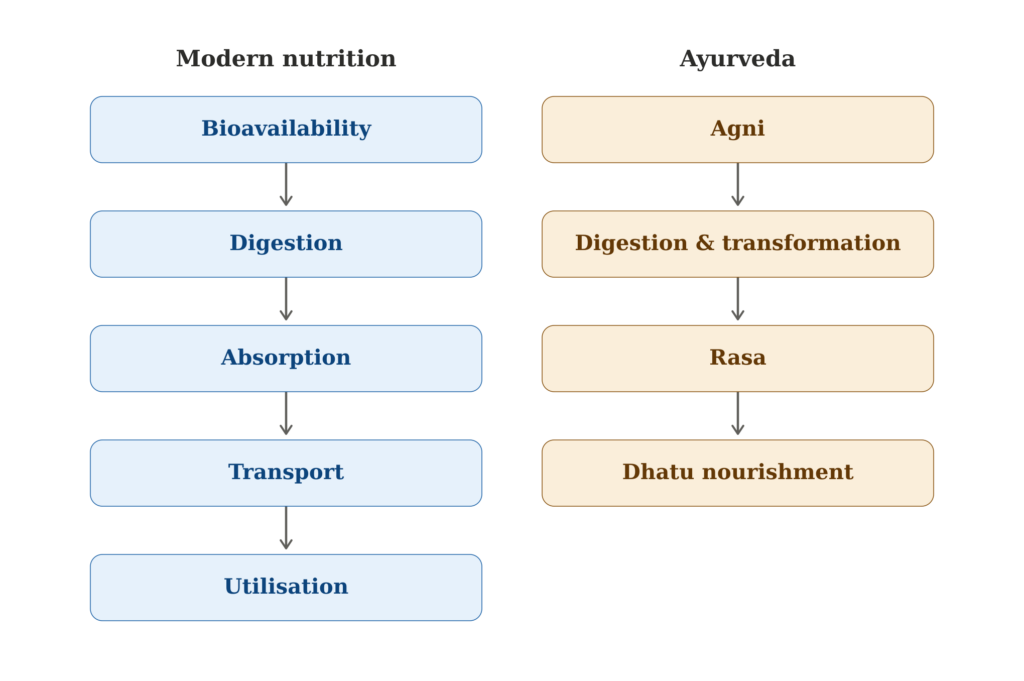
Different frameworks. An intriguing shared question.
And this is where I have to turn the question back on myself.
Was I, without realising it, building more Ama into my body since becoming pregnant?
Because when I actually looked at what pregnancy had done to my diet, it wasn’t only the iron tablet sitting next to my breakfast. It was the whole pattern underneath it. The uncontrolled cravings. The cold breakfast, every single morning, when Agni has traditionally been considered stronger in response to a warm, cooked meal. The daily, near-ritual combination of milk and yoghurt with banana and raw fruit — my favourite pairing, reached for almost without thinking, day after day.
Individually, none of this is wrong. Milk is nourishing. Yoghurt is nourishing. Bananas and fresh fruit are nourishing. My body, growing another human being, genuinely needed the calcium, the protein, the potassium, the vitamin C sitting in that bowl.
But Ayurveda has a specific name for what happens when otherwise wholesome foods are combined in ways the body isn’t well equipped to process together: Viruddha Ahara, incompatible food combining. And milk with fruit — bananas in particular — is one of its most classic, most frequently cited examples. Not because either food is harmful on its own, but because dairy and fruit are traditionally held to require different digestive conditions, and combining them is described as generating exactly the kind of undigested residue Ayurveda calls Ama.
So I have to ask the question honestly, and sit with not fully knowing the answer: was that daily bowl — comforting, craved, genuinely nutritious on paper — also quietly working against me? Was I, meal after meal, laying down more Ama at the exact moment my body most needed Agni to be strong, in order to build blood for two?
I want to resist the temptation to answer that too neatly. I can’t point to a lab value for Ama. I can’t prove my ferritin dropped because of a fruit-and-yoghurt bowl rather than simply because pregnancy is enormously iron-hungry, or because of the calcium-and-iron interaction I already described. What I can say is that Ayurveda would have flagged this exact combination as digestively taxing long before anything showed up on paper — and that, whatever the underlying mechanism, the shape of the pattern still fits: comforting food, taken without thought to compatibility or timing, piled onto a body already under strain.
And then we arrive at Rasa and Rakta Dhatu
This became especially fascinating to me because iron is so intimately tied to blood physiology.
Ayurveda describes seven principal Dhatus, or tissue systems. The first is Rasa Dhatu, associated with the body’s primary nourishing fluids and the distribution of nourishment following digestion. The second is Rakta Dhatu, associated with blood, vitality and life-sustaining function.
In the classical model, nourishment doesn’t leap directly from food into tissue. There is a sequence of transformation, tissue by tissue. So from an Ayurvedic lens, asking about low iron or poor Rakta nourishment becomes more layered than simply asking how much iron am I eating. We might also ask: How is Agni functioning? Is there evidence of Ama? How is Rasa being nourished? Is that nourishment reaching Rakta?
This doesn’t replace checking haemoglobin, ferritin or other lab markers. Nor does it mean every case of iron deficiency is caused by poor digestion. Pregnancy alone dramatically increases iron requirements, and blood loss, diet, absorption disorders and countless other factors contribute.
But Ayurveda adds a dimension modern supplement culture rarely mentions: nourishment isn’t only about intake. It’s about transformation and assimilation.
Our supplement culture rarely talks about this
Look inside many people’s kitchen cupboards today and you might find iron, magnesium, calcium, zinc, vitamin D, B12, prenatal vitamins, probiotics, herbal preparations — several of them swallowed together over breakfast, on the assumption: I took it, therefore my body received it.
But nutrition isn’t that simple. Some nutrients compete. Some compounds inhibit absorption, others enhance it. Some supplements are better tolerated with food; others may be better absorbed away from it. And — as the hepcidin research shows — even the same supplement, taken too close to its own last dose, can absorb worse than expected.
This doesn’t mean everyone needs an elaborate vitamin timetable. But perhaps we should start asking, alongside “what should I take?” — “how, and when, should I take it?”
What I changed — imperfectly
My iron now gets its own window, separate from my prenatal supplements and away from dairy, calcium-containing supplements, tea, coffee and high-phytate foods like cereal.
I want to be honest that this hasn’t turned me back into someone eating warm kitchari every morning. Pregnancy is still pregnancy — some mornings muesli is still what I can manage, and I’ve made peace with that. But I’ve stopped stacking everything into one indiscriminate handful at the breakfast table simply because that was the easiest thing to remember. I give the iron its own moment. I pair it, when I can, with something rich in vitamin C. And I’ve stopped assuming that swallowing a tablet is the end of the story.
Importantly, I’m continuing to monitor my blood values with my doctor, because changing supplement timing is not a substitute for medical care. When ferritin and haemoglobin continue declining despite therapeutic oral iron, that deserves proper follow-up — sometimes oral dosing needs adjusting, sometimes another cause needs investigating, and in some cases intravenous iron is the right path. This article isn’t a replacement for any of that.
But there was something almost beautifully Ayurvedic about the small change I made — not because separating calcium from iron is itself an Ayurvedic discovery, it isn’t, but because I stopped treating my supplements as something I simply had to put into my body, and started thinking about the environment into which I was putting them.
Perhaps the lesson isn’t really about iron
My blood test taught me something bigger than how to take one mineral.
We tend to think about nutrition quantitatively. Did I eat enough protein? Did I get enough iron? How many milligrams did I take? But there’s another question underneath: how much of what I consume actually becomes nourishment?
Modern nutritional science gives us bioavailability, hepcidin, absorption and nutrient interactions. Ayurveda gives us Agni, Ama, Rasa and Dhatu nourishment. They shouldn’t be collapsed into one another — Ama isn’t simply “poor absorption,” Agni isn’t simply “digestive enzymes,” Rasa isn’t simply plasma, Rakta isn’t simply a haemoglobin number. Each belongs to its own system of understanding the body.
But perhaps that’s precisely why placing the two beside each other is so interesting. Both challenge the same quiet assumption: that consumption equals nourishment.
Taking something is only the beginning. And especially in a season like pregnancy — when routine falls apart, when the body wants what it wants, when doing everything “right” simply isn’t available to you — that’s a forgiving thought to hold onto. It isn’t only what you take. It’s what you’re able to digest, transform, and ultimately receive.
Supplement Absorption & Timing Reference
A reference table for the most common supplements people stack together today, focused specifically on absorption conflicts and practical timing.
| Supplement | Nutrients/foods that block it | Other supplements that block it | Best timing & pairing |
|---|---|---|---|
| Iron | Calcium, tannins/polyphenols (tea, coffee), phytates (cereals, legumes, nuts) | Calcium, zinc, magnesium | Empty stomach, morning, with vitamin C. Keep 2–4 hours from dairy, tea/coffee, and other minerals. If taking a high dose, alternate-day dosing may absorb better than daily (ask your doctor). |
| Calcium | High-oxalate foods (spinach, chard), high-phytate foods, excess sodium | Iron, magnesium, zinc | Best absorbed in split doses of ≤500mg, ideally with a meal. Space 2+ hours from iron. |
| Magnesium | High-dose calcium, high-phytate diets | Calcium (at high doses), zinc (at high doses) | Evening, with food — supports sleep and is gentler on digestion this way. Space from calcium/iron if taking high doses of either. |
| Zinc | Calcium, high-phytate foods (whole grains, legumes) | Iron (at doses ≥25mg), copper, magnesium (at high doses) | With a meal to avoid stomach upset; separate from iron and calcium by a couple of hours. Long-term high-dose zinc can deplete copper — worth flagging to your doctor if taken chronically. |
| Vitamin D | — | High-dose magnesium can affect how vitamin D is metabolised (they work together, not against each other, but adequate magnesium status matters for D to activate properly) | With a meal containing some fat — it’s fat-soluble and absorbs poorly on an empty stomach. |
| Vitamin B12 | Long-term acid reducers (PPIs), high-dose vitamin C taken at the exact same moment (may reduce measured B12 slightly, though clinical significance is debated) | — | Any time, ideally with food. Sublingual or with meals if you have absorption concerns (common in pregnancy and with certain gut conditions). |
| Folate / Folic acid | — | Zinc (mild competitive effect at high doses) | With food, any time of day. No major known food blockers. |
| Omega-3 (fish oil) | — | — | With a meal containing fat — improves absorption and reduces the chance of “fishy” burps. |
| Probiotics | Very hot food/drink taken at the same moment, high-dose antibiotics taken simultaneously | — | Follow the product’s label — some strains are best on an empty stomach, others with food. If taking antibiotics, space by at least 2 hours. |
| Prenatal multivitamin | Contains calcium, magnesium, zinc, iron together — meaning it competes with itself | Standalone iron, calcium, or zinc supplements taken at the same time | Take with food to reduce nausea. If you’re also taking standalone iron, separate them by several hours rather than doubling up at breakfast. |
| Vitamin C | — | — | Enhances iron absorption when paired with it. No major blockers of its own; water-soluble, so timing is flexible. |
A simple daily shape, if you’re juggling several of these:
- Morning, empty stomach: iron + vitamin C
- With breakfast or lunch (a meal with some fat): vitamin D, omega-3, prenatal multivitamin
- Midday, away from other minerals: zinc
- Evening, with dinner: calcium, magnesium
- Whenever, with food: B12, folate, probiotics (per label)
This is a general framework, not a prescription — actual needs, doses, and interactions (especially in pregnancy, or alongside medications) should be confirmed with your doctor or midwife if pregnant.

