

Why Do I Feel Guilty All the Time? An Ayurvedic Perspective on Guilt
9/08/2026

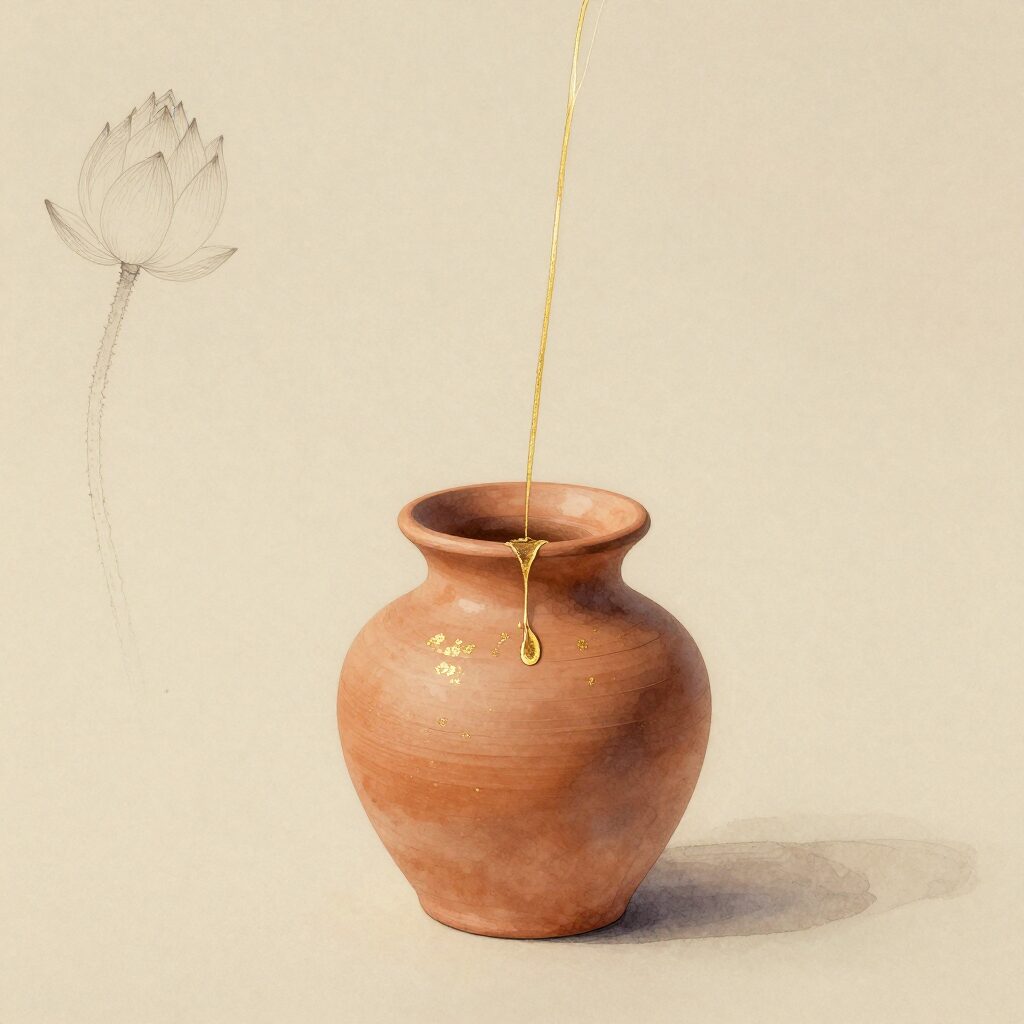
Understanding the emotional weight we carry, why guilt can become so difficult to release, and how Ayurveda invites us back into balance.
There is a particular kind of tiredness that has nothing to do with sleep.
I have felt it in my chest at three in the morning, replaying old conversations. Some of them ended years ago, some were recent. Sometimes I have felt this tiredness in my shoulders while sitting perfectly still, as if somehow I was paying for something. For a long time I thought this was simply how a conscientious person feels: a little heavy, a little responsible, a little sorry, always.
It took me years of sitting with my own body, to understand that what I was carrying had a name, a weight, and a physiology.
Guilt is not only a thought we have. It is something the body metabolizes, or fails to.
Ayurveda, in most people’s minds, lives in the kitchen and the spice cabinet – turmeric for inflammation, ghee for dryness, a soothing tea for a restless stomach. What almost nobody tells you is that the very same science that maps how your body digests food also maps, how your mind digests an emotion.
The Many Faces of Guilt
Guilt rarely announces itself as one thing. In my practice and in my own life, I have come to recognize at least a few distinct forms, each with a different texture and a different root.
There is healthy guilt
The quick, clean pang that arises when we have genuinely stepped outside our own Dharma, our sense of right action. This kind of guilt is not a sickness. It is closer to a compass needle correcting itself. It says look here, and once we look, apologize, repair, it dissolves. This is guilt doing exactly its job.
Then there is neurotic or misplaced guilt
The guilt that persists long after any repair is possible, or that was never proportionate to begin with. The guilt of the daughter who left home to build her own life. The guilt of the mother who rested instead of tending to everyone else first. The guilt of simply wanting something for yourself in a family, a culture, that equates self-denial with virtue. This guilt does not point to a real transgression against Dharma. It points to an old, internalized voice — often inherited, rarely our own.
There is survivor’s guilt
The strange debt we feel to those who suffered more, or did not make it through at all.
And there is ancestral or inherited guilt
Close to what the Vedic tradition calls Pitru Rin, a debt to one’s lineage — guilt that was never ours to begin with, passed down like an heirloom nobody wanted, carried in the body of a descendant who has no memory of the original wound.
And finally, there is existential guilt
The low, ambient hum of feeling that we are somehow not living up to our own becoming, unrelated to any single act. This is perhaps the most Vedic form of all, because it touches directly on Purusharthas — our sense of whether we are moving toward Dharma, Artha, Kama, and ultimately Moksha, or drifting from it.
Naming which kind of guilt we are holding is the first act of digestion. You cannot digest what you cannot yet see clearly.
What Guilt Does to the Body
In the biomedical frame, chronic guilt behaves like any other sustained stress response. It keeps the nervous system tilted toward sympathetic activation. Cortisol stays elevated. Sleep architecture fragments. Digestion, ironically and fittingly, is often one of the first systems to falter. Guilt is one of the few emotions that people describe somatically as sitting in the stomach or the chest, a felt heaviness rather than an abstract thought.
Ayurveda would not find this surprising in the slightest. It would simply ask you to go one layer deeper.
Ama: When an Emotion Is Not Digested
At the center of Ayurvedic physiology sits Agni — the digestive fire, the intelligence that transforms what is taken in into what nourishes. When Agni is strong, food becomes tissue, tissue becomes vitality, vitality becomes Ojas — the subtle essence of vigor and immunity, often described as the very ground of our radiance. When Agni is weak, food does not transform. It sits, half-broken-down, and turns into Ama — a sticky, toxic residue that the body was never meant to hold.
What almost never makes it into the popular retelling of Ayurveda is this: Agni is not only in the gut. There is a Manas Agni — a digestive fire of the mind — governing how we metabolize experience, sensation, and emotion, in exactly the way that Jatharagni governs how we metabolize food. An emotion, in this framework, is not so different from a meal. It arrives, it needs to be tasted, broken down, and either absorbed as understanding or released as waste. Guilt that is felt, examined, repaired where possible, and let go — that guilt has been digested. It becomes wisdom, discernment, a slightly wiser Buddhi. But guilt that is swallowed whole and never processed — denied, suppressed, argued with, buried under busyness — behaves exactly like undigested food. It turns into Ama.
Emotional Ama does not stay in the mind. It travels through the Manovaha Srotas, the channel of the mind, and from there it settles — the way Ama always settles, in the weakest or most receptive tissue of a given constitution. In a Vata-dominant person, it often lodges as anxiety, insomnia, a racing and self-punishing internal monologue. In a Pitta-dominant person, it frequently shows as self-criticism sharp enough to burn — a kind of internal litigation that never adjourns. In Kapha, it can settle as heaviness, a low mood that resists movement, a stuckness in the body that mirrors the stuckness of the unprocessed feeling.
Left long enough, classical Ayurveda describes Ama as moving progressively deeper through the Dhatus — the seven tissues, from Rasa (plasma) to Rakta (blood) to Mamsa (muscle) — and, in its most chronic expression, reaching Majja Dhatu, the nerve tissue, and Asthi, bone. This is the waterfall within I have written about before in the context of chronic fatigue: depletion and toxicity do not arrive all at once. They cascade, tissue by tissue, until what began as a feeling in the chest has become a pattern in the nervous system itself — chronic tension, chronic fatigue, autoimmune flares, a body that has, in the most literal sense, been carrying something for far too long.
This is what I mean when I say guilt can cloud the essence. Ojas is meant to be luminous — it is often described as what gives the eyes their brightness, the skin its vitality, the mind its clarity and courage. Ama is its opposite: dull, heavy, obscuring. A person who has been sitting in undigested guilt for years often describes themselves, without quite knowing why, as foggy. Not sick, exactly. Just unclear. Distant from their own aliveness. Unfree.
Guilt as a Doshic Imbalance, Not a Moral Failing
I want to underline something here, because it is easy to miss: Ayurveda does not moralize guilt. It does not ask whether you should feel it. It asks what it is doing to your Prakriti — your natural constitution — and how far you have drifted from your Vikriti-free state. This reframing alone is, for many of my clients, the beginning of relief.
Guilt stops being a verdict on your character and becomes, instead, a Doshic weather pattern:
- Vata destabilized by rumination
- Pitta inflamed by self-judgment
- Kapha weighed down by stagnation.
The Ayurvedic Approach to Emotional Illness
Classical Ayurveda names three broad categories of therapy:
- Daivavyapashraya Chikitsa (spiritual therapy — mantra, prayer, ritual, the invoking of a larger order of meaning)
- Yuktivyapashraya Chikitsa (rational therapy — herbs, diet, medicated oils, the direct treatment of the body-mind)
- Sattvavajaya Chikitsa — which translates, roughly, as the victory of Sattva, and which is, quite plainly, Ayurvedic psychotherapy.
Sattvavajaya Chikitsa works by withdrawing the mind from harmful, Rajasic or Tamasic thought loops — guilt’s endless replaying, its self-punishing narration — and cultivating Sattva: clarity, discernment, steadiness. In practice, this looks like guided self-inquiry into the true nature and origin of the guilt (is this Dharmic guilt, asking for repair, or inherited guilt, asking only to be released?), the cultivation of witness-consciousness so the guilt can be observed rather than fused with, and often, classical counsel drawn directly from the Bhagavad Gita’s teachings on right action performed without attachment to outcome — a teaching that speaks almost directly to the guilt of not having done enough, or done it perfectly.
This is where I want to push back on the idea that Ayurveda is only for the physical body. The very same tradition that will ask about your bowel movements and your sleep, also will ask what you are still carrying from your mother, your childhood, your twenties, your failed relationships etc.
How We Actually Digest Guilt: The Practice
Healing undigested guilt, Ayurvedically, is rarely one dramatic release. It is closer to slowly rekindling a fire that has gone dim, so the body-mind can finally do the metabolic work it has been unable to do alone.
Dinacharya, the daily rhythm
This is the quiet foundation of this. Rising with or before the sun regulates the nervous system in a way that directly supports Manas Agni — a mind that has slept and woken in rhythm has more capacity to process what arises during the day, rather than stockpiling it.
Self-massage, Abhyanga
With warm sesame or Vata-pacifying oil, does something that talk alone cannot: it works at the level of the tissues where old guilt has settled, softening what has hardened, literally increasing circulation to areas of the body that chronic tension has made numb.
Shirodhara
The slow, continuous stream of warm oil poured over the forehead — is, in my experience and in classical description alike, one of the most direct therapies for exactly this kind of stored emotional weight. It calms Vata at the level of the mind, quiets the Manovaha Srotas, and creates the kind of deep parasympathetic stillness in which old, buried material is finally allowed to surface and move rather than remain frozen in place.
Nutrition
Plays its part too, and here I always ask people to notice Viruddha Ahara: incompatible food combinations. Try to notice not only for what they do to physical digestion but for how a weak Jatharagni leaves less reserve for Manas Agni. A body working overtime to digest a difficult meal has little left over to digest a difficult memory. Warm, cooked, easily assimilated food; the reduction of excess caffeine and stimulation for a Vata-agitated mind; the inclusion of Rasayana herbs such as Brahmi and Ashwagandha, both traditionally indicated for strengthening Majja Dhatu and steadying a mind that guilt has made restless.
Becoming Free
Freedom, in the Vedic sense, was never about never feeling guilt. It is about guilt passing through you the way food is meant to pass through a healthy Agni — fully metabolized, leaving behind only what nourishes: a clearer sense of Dharma, a gentler self, an Ojas undimmed. The goal was never a spotless conscience. It was a digested one.
If you have been carrying something for a long time, a decision, an old harm, a debt that was never really yours, then I want you to consider the possibility that this is not a character flaw to manage for the rest of your life. It may simply be Ama, asking, finally, to be metabolized. And there is a very old science that already knows exactly how.
If this is resonating, and you sense there is guilt or old emotional weight your body has been carrying, an Ayurvedic assessment can help identify where it has settled in your constitution — and what, specifically, your body needs to finally let it move.

